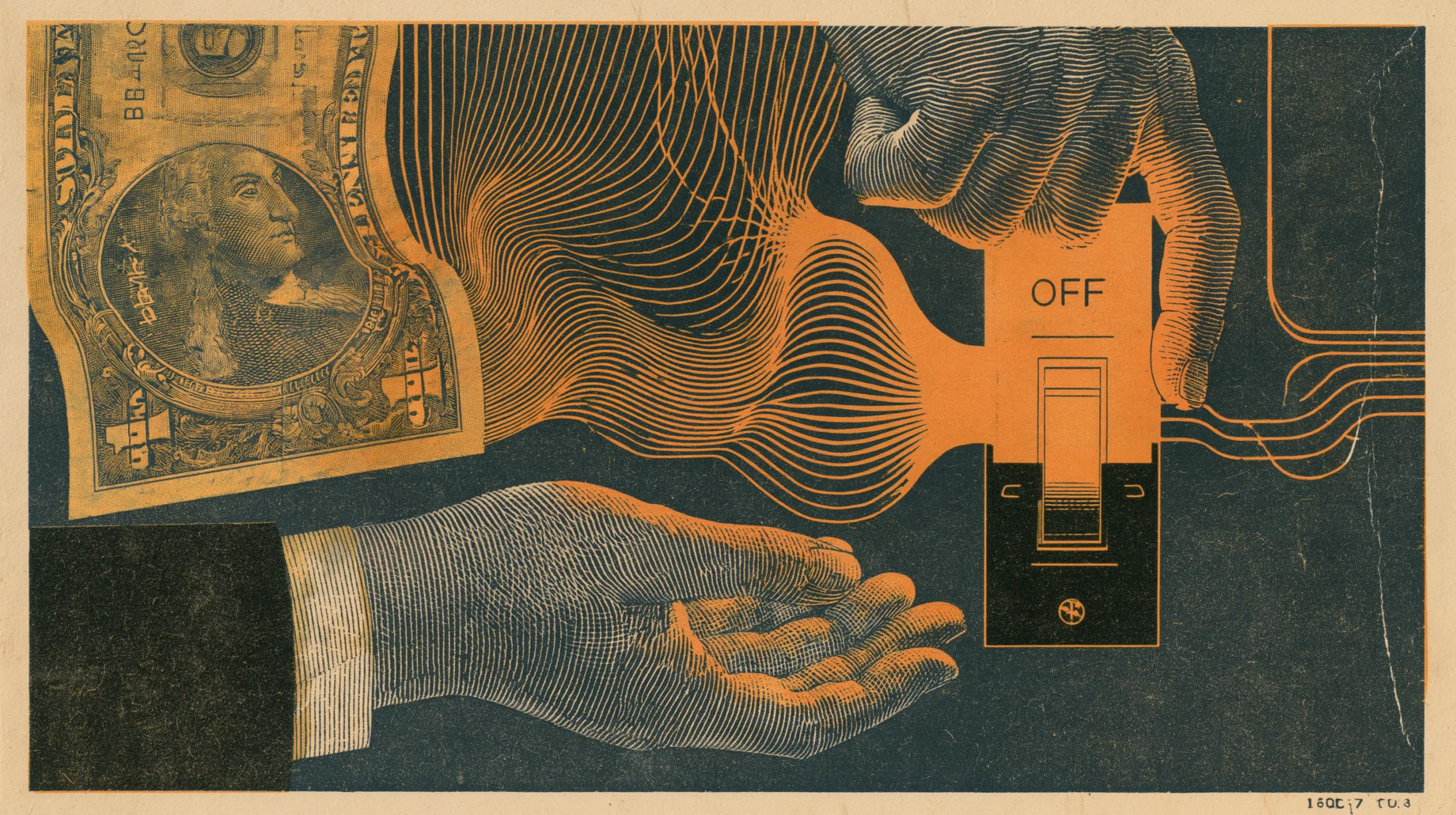
Today’s money lets the state punish you after the fact, through other people, with plenty of leaks. A central bank digital currency plus AI lets the system decide in advance, automatically and person by person, what your money will and won’t do. And nobody has to intend it. Every step toward it is a reasonable person doing their job, and a crisis is what makes the next step look obvious.
What today’s money can’t do
The pounds you spend live in two forms. Notes and coins in your pocket, and deposits at a commercial bank, which are an IOU from the bank to you [the bank owes you that money and promises to pay it when you ask]. The state is at a distance from both. If it wants to freeze your account, it needs a legal order and a bank willing to act on it, one holder at a time. If it wants to stop you buying something, it passes a law and then has to catch you afterwards, through police and courts. If it wants to get money to millions of people quickly, it pushes payments through banks and waits. And if it sets interest rates below zero, you can walk to a cash machine, take out notes, and opt out. That’s a large part of why rates never went far below zero anywhere. Cash is a floor.
The control that exists today is slow and blunt. It needs people at every step, applies one rule to everyone, and leaks. Most of that friction wasn’t designed as a protection, but it works as one.
What a CBDC changes
A central bank digital currency [money issued directly by the central bank, where your balance is a line on its own ledger rather than a claim on a high-street bank] changes the architecture of the money, while what you see on your phone stays familiar. The central bank issues the money and keeps the account your balance sits in, whoever hands you the app. And once your balance is on the issuer’s own ledger, the money itself can carry rules. That’s what programmable means [the money enforces rules about how, when, and where it can be spent, inside the payment itself].
None of this fits inside today’s money.
- Interest below zero, with no exit. The wallet can take it straight from your balance. Once cash is gone, or too marginal to matter, the floor is gone. A committee can decide savers lose 4% this year, and the decision executes itself.
- Money that expires. A balance that decays unless you spend it, say 6% a year, or a stimulus payment that vanishes if unspent after a month. Today notes and bank deposits don’t have clocks in them. On a ledger, spending deadlines are a setting.
- Payments that fail at the till. Today a law says what you may not buy, and someone else has to enforce it. A shopkeeper who checks your age, a card issuer who blocks a category, or police and courts after the fact. In a CBDC the rule runs inside the transaction. The payment for the flight, or the second tank of petrol this week, or anything outside your area in an emergency, simply doesn’t go through, with no officer, no court, and no appeal in the moment. The rule and the enforcement become the same event.
- Freezing at a keystroke. Today, freezing assets is done one holder at a time, through institutions that each have to act. On a single ledger it can be done to everyone at once. Any balance, any group of balances, instantly.
- Transfers with strings attached. Support payments that arrive tied to your digital identity, spendable only on approved categories, only by a certain date. The furlough payment, but with the conditions built into the money.
- Total visibility. Every transaction by every person, visible to the issuer in real time. Today’s system is surveilled, but the records sit in separate banks that never share one view. One ledger removes that separation.
What AI adds
The ledger gives the levers. AI supplies the hands to pull millions of them at once. Each control above still sounds like it needs an army of officials, and it doesn’t.
1.Reading
No workforce on earth could watch tens of millions of transactions a day. A model can, in real time, and it gets better at spotting whatever it’s told to spot, because every flag a person confirms or rejects becomes training data for the next pass. On a narrow, well-defined job like this one, they correct their own errors faster than any human process.
2.Personalising
Today policy is one interest rate and one rulebook for everyone, and not because anyone chose fairness. Administering different rules for each person was impossibly expensive. AI makes per-person rules cheap. Your money can carry different limits from your neighbour’s, set by a model scoring your behaviour, updated continuously. And the pitch writes itself. Personalised policy means shorter recessions, targeted help, less fraud.
3.Enforcing
The rules execute without staff. People may still review the model’s flags, but that checks the model’s work, not your case. What goes is the bank clerk between the rule and your payment, the person who could have looked at it and said no, this one’s not right.
Put identity, payments, and AI in the same system and you get the end state. A person can be switched off from economic life, unable to pay or be paid, by a flag in a database. Today that takes a bank here and a platform there, each deciding separately, and it leaks. In that system, it’s instant and total.
Why it arrives through the next crisis, with no villain required
Our money is debt-based. Nearly all new pounds are created when banks make loans, and those debts are fixed in pounds. If prices and wages broadly fall, the repayments don’t shrink with them, so the debt takes a bigger bite of every income. Enough of that means defaults cascading through the banks. So the system must keep prices rising, whatever anyone prefers. It’s a survival condition of the structure.
AI pushes prices down harder every year, because its entire purpose is more output from less labour. It also cuts jobs fast when firms get squeezed. So the deflationary pressure the system must offset gets stronger every year, and the next downturn likely arrives with a lot of people losing income at once.
What do governments do then? We rehearsed the answer in the pandemic. Direct payments and payment holidays, fast and to millions. The central banker who refuses to ease [cut rates and create new money] sees banks fail on their watch, so they ease. The politician promising relief beats the one promising a hard lesson in sound money, election after election. The Treasury official told to reach every citizen by Friday looks at bank transfers and the million people with no bank account, and concludes that a digital wallet at the central bank is the efficient answer. And the voter takes the payment, because the relief is immediate and certain, while the cost, less freedom later, is uncertain and far off. Humans under stress take the certain thing. Every actor in that chain does their job reasonably, and none of them has to want the result.
The controls arrive switched off. The Bank of England’s promises about a digital pound haven’t changed. No programmability by the Bank or the government, privacy protected, cash to remain. I don’t doubt the sincerity. But those promises are launch-day settings, and settings get revisited under pressure. Once the switch exists, the next emergency finds it. In a crisis speed beats deliberation, the carve-out arrives labelled temporary, and emergency powers persist because removing them re-exposes the fragility they were covering. And each round of relief manufactures the next emergency. The new money pushes prices up faster than wages, which makes people angrier, which invites spending rules and capital controls [rules that stop money moving across borders or into certain assets] to manage the anger the last round created.
A conspiracy would be a more comforting story, because you could remove the conspirators. Incentives stay when the people change.
The reasons not to worry
“Safeguards will be legislated.”
They will, and I’d still expect them to bend, because money outranks law in practice. When preserving the monetary system requires a power, laws get reinterpreted to fit. Emergency after emergency has bent them before. The only protection that survives is the one that’s structurally impossible to override.
“Banks already see everything, so nothing changes.”
Partly true, and it misses the change. Today’s surveillance is fragmented, slow, and has a cash exit. The change is architectural, with one ledger, rules executing inside the payment, and, once cash is gone, no floor under rates. Concentration is the difference.
“Personalised policy is good. Shorter recessions, targeted help.”
The benefits are real, which is exactly why it gets adopted. But the same fine-grained control that targets help targets punishment, and which one it does is decided by whoever holds the controls in the next crisis. The launch-day intent doesn’t get a vote.
The same AI running on a money nobody can expand produces the opposite world. The gains show up as falling prices, so people need less income to live, and the case for mass transfers, and the conditions that ride along with them, shrinks rather than grows. That’s why the two systems can’t share the future. One needs control to survive. The other removes the lever the control depends on. Which money we all stand on when the AI wave fully lands is what decides which of those two worlds we get.