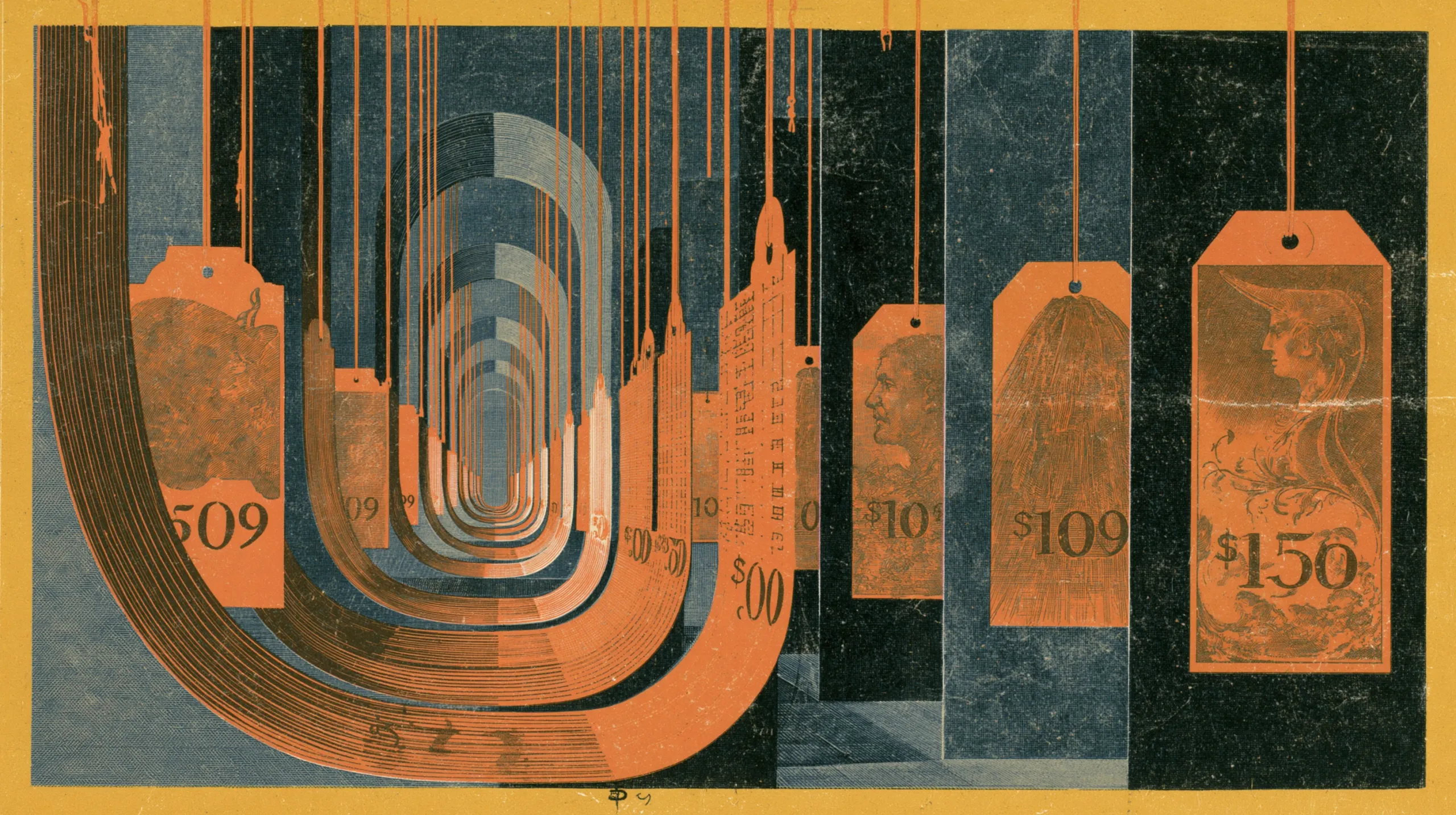
Wherever businesses are free to compete, the price of a thing is made of two parts. What it costs to make, and a profit on top. The profit is never safe. A big profit tells other businesses there’s easy money to be made, and one of them can take the customers by offering them more for less. So the profit gets competed away until the price ends up just above what the thing costs to make. That’s half of the answer. The other half is that the cost of making things is falling as well, and that fall should get faster with time. Competition pushes the price down to the cost, and stops there. Technology pushes the cost down, and doesn’t stop.
If prices fall on their own, why does your weekly shop keep costing more? Because almost every price you see has two things pushing on it at once. Technology pushes the cost of making the thing down. New money pushes the price you pay up, because more of it keeps being created, and when there’s more money around, each pound or dollar buys less. It takes far less to grow, ship, and brew coffee than it did decades ago, and the price at the till still went up, mostly because the money lost value faster than the coffee got cheaper to make. New money doesn’t stop the fall in what it takes to make things. It hides the fall in the price you pay, and how much of it you get to see depends on what’s happening to the money.
Technology hasn’t made everything cheaper to make. Caring for someone, teaching a class, and building a house still take about as long as they always did, so they get dearer next to the things that have got cheaper to make. And new money pushes their prices up as well, house prices most of all.
The squeeze
Falling prices start with the customer. Given two versions of the same thing, most people pick the cheaper one, or the better one at the same price. You do it at the supermarket without thinking, and nearly everywhere else you spend money. That one habit is what forces prices down.
Now say you run a business and you’re looking for a market to get into. A product that sells for a lot more than it looks like it costs to make is a signal. It tells you there’s room to come in cheaper. You can’t win its customers by offering the same thing at the same price, because they’d have no reason to move. You win them by charging less, or by offering something better, or both. The business already there then has a choice. Match you, or lose its customers. Matching means cutting its price, or spending money to catch up with your better product. Either way its profit shrinks. And once it has matched, the next business comes in and the same thing happens again.
So why doesn’t the price keep falling all the way to nothing? Because there’s a limit on each side. A business can’t sell below what the thing costs to make, not for long, because then every sale loses it money. But any price held well above that cost leaves room for someone else to come in cheaper and still make a profit. So the price gets pushed down from above and held up from below, until it settles just above what it costs to make one more of the thing, once the business is up and running. Economists call that the marginal cost. The little on top of it is what it takes to keep the business running.
Profit doesn’t disappear in all this. It moves. You make your money while the price is on its way down. When it reaches the bottom, the money and the people who earned it move on to the next thing that’s still scarce, whether or not the business survives. Often the next scarce thing is the way to reach customers, the search box, the app store, or the feed, and much of the profit has landed with the few businesses that own them. Storing photos went close to free, and the profit moved into tools for organising and sharing them. The calculator app went from something you paid for to a free line of code, and the developers moved on. And the money customers save on the old thing is what they spend on the next one. That’s why people keep investing in things whose prices are falling. Money was made in streaming, where the price per play collapsed, in budget airlines, and in software that businesses rent instead of buy, while the price kept dropping, because lower prices bring in more customers.
Competition looks like a fight between businesses, but what it does is force each one to serve the customer better than the last one did. Where anyone is free to enter a market, that’s the only way to win. So a free market makes things plentiful and cheap over time, instead of letting whoever got there first charge whatever they like.
A business can try to hold its price up when its costs fall, and for a while that works. Customers stick with the names they know, so brand and habit slow the fall, and some buyers will pay more for a name for as long as they value it. But a price held above cost is exactly the signal that brings the next rival in, so a name on its own doesn’t keep rivals out. Only one thing holds the fall back for long, and that’s a wall. A licence that keeps new businesses out. A regulation written by the big firms already in the market. Protection from the government. Or first access to newly created money, which lets a big firm outlast smaller rivals it couldn’t beat on price. Some walls a business builds for itself. A secret way of making the thing. A head start. The trouble it takes a customer to switch. A network the customer won’t leave because everyone else is on it. Behind a wall, the saving stays with the business as profit. Across American business, the gap between what things sell for and what they cost to make has widened since 1980. That’s what walls look like in the figures.
But a monopoly that lasts a while is normal, and it can happen in any market. A product that gets better as more people use it can keep one winner in place for a decade or more, often by being cheap or free to the people using it. A monopoly that keeps prices high for decades is almost always leaning on one of those walls. That’s a market that has been blocked, not one that failed. And it’s that wall, not falling prices, that stops people building new businesses. You can’t compete head-on with a rival the law protects, and you’ll rarely take a network’s customers by copying it.
Why the fall should speed up
Competition can only take a price down as far as the cost of making the thing. Once the price gets there, it has nowhere left to go. So competition on its own would run out of room, and fiercer competition would only get there sooner. What has no end in sight is the fall in the cost of making things. That’s where the speeding up would come from, and there are five reasons to expect it.
The official figures don’t show the speed-up yet. How much a worker produces in an hour grew about 2% a year in the UK in the ten years before 2008, and between 0.7% and 1.3% a year from 2009 to 2019, depending on which of the statisticians’ two measures you take. The American figures slowed too. The figures do miss part of the fall, because they leave out things that carry no price, but on the measures tried so far that’s a small part. Where the speed-up shows is in what the tools can do. The cost of getting the same standard of answer from an AI fell more than 280-fold in under two years. Gains like that reach the cost of making things with a delay.
1.Tools compound
Most improvements help make the next improvement. Better chips make better software, better software designs better chips, and now machines help build the machines. When each gain builds on the last, the steps get bigger over time, not smaller. We’re used to progress coming in steady steps, so each time the steps get bigger we expect them to settle back to the old size. Taken all together, so far they haven’t, and that’s why new technology keeps taking people by surprise.
2.More of the economy keeps turning into information
A song used to be a disc, and now it’s a file. A map used to be paper, and now it’s an app. The design of a product is becoming a file that a machine can print close to the buyer. And more and more, a diagnosis, or the first draft of a contract, comes from an AI in under a minute. Once a thing is information, making one more of it means making a copy, and a copy costs almost nothing. So the price of a copy heads toward free. Software did this to one set of tasks, AI is doing it to work that used to need a trained person at a desk, and robots are carrying the same change into warehouses and factories. Year after year a bigger share of the work in the economy goes into things that cost almost nothing to copy, so the fall in the cost of making things, across the whole economy, should get steeper.
The price of playing a song fell to almost nothing. Your streaming bill has gone up all the same. It pays for making new music and programmes, and making them isn’t copying them. Like almost every price you pay, it carries the new money on top.
3.The competing itself got faster
Opening an online shop used to need a team of programmers and years of building. Today someone can rent the tools for about £50 a month and sell to the whole world from a laptop. When starting a rival gets that cheap, a big profit gets noticed sooner, and attacked sooner, as long as the rival can reach customers without going through the business it’s attacking. Competing a price down to its cost once took a generation. Now it can take a few years. So where that route is open, competition itself, pushing the price down to the cost, happens faster than it used to. And it brings the cheaper way of making the thing in sooner, because the business that doesn’t take it up loses to the one that does.
4.The floor under every floor is sinking
Every step in making or moving anything uses energy, including digging up and shaping the materials. So a fall in the cost of making energy pulls almost every other price down. The pull is small at first, because energy is a small part of what most things cost to make. The pull grows with time, because cheap energy makes it worth using ways of making things that use a lot of energy, and then energy is a bigger part of what those things cost to make. And the cheapest way of making energy keeps getting cheaper. Each time the total number of solar panels the world has ever made doubles, the cost of a panel falls by about a fifth. That pattern has a name, Swanson’s Law. Batteries for storing the power are following a similar path. Your energy bill hasn’t followed, and you’re not misreading it. The bill is a price like any other, so it carries the new money on top, and it pays for a lot more than the making of the energy. What keeps falling is the least it can cost to make energy at all, and since energy goes into everything made, the lowest point the price of anything made can fall to is itself getting lower.
5.The fight against the fall speeds the fall up
When new money is created to keep prices rising, wages rise too. So a business faces a bigger wage bill while its customers still want more for less. It can’t pay its staff more and charge its customers less at the same time, so it replaces people with machines sooner than it otherwise would. The café puts in a self-order screen. The supermarket puts in self-checkout. Where every rival faces the same wage rise at once, a business can also raise its prices or trim what the customer gets, for as long as customers pay. The pull toward the machine stays, because the first rival to bring one in can charge less or serve better. Each round of new money meant to hold prices up brings forward the technology that pushes costs down. That leaves a bigger fall to cancel next time, and cancelling it takes more new money.
Why the fall doesn’t settle down
So why doesn’t the fall ever settle down? For that to happen, one of three things would have to be true. New inventions would have to stop, and they don’t, because solving one problem makes the tools for solving the next one cheaper. New businesses would have to stop coming in, and where the way in is open they don’t, because a new profit keeps appearing somewhere to chase. Or the cost of making things would have to hit a bottom that holds, and it doesn’t, because the least it costs to make energy keeps falling, and energy goes into everything. Taken on its own, any one technology does flatten out eventually. The chips inside computers are getting harder to shrink, and people point at that and say the speeding up must be over. But as one technology flattens, the ones already under way keep compounding, and a new one often starts as the old one matures. What counts for the cost of making things is all of them added together. AI models keep improving on the same chips. Robots take software out into the physical world. As energy gets cheaper to make, so does almost everything else. Computing, then software, then AI, then robots, with energy getting cheaper to make underneath all of them. No single breakthrough is needed. Ordinary improvements, each building on the last, are enough.
So competition pushes the price of a thing down to what it costs to make, and technology pushes that cost down and doesn’t stop. Wherever businesses are free to compete, prices should fall, and the fall should get bigger with time. Under money nobody could add to, prices would fall. There’s a word for that, deflation. Here it means prices falling because we got better at making things. Prices can also fall because people have stopped buying, and that’s a different thing with the same name. The good kind of fall is where the hard part of the thesis starts. Nearly all the money we use is created when somebody borrows. A debt doesn’t shrink when prices fall, but the money coming in to pay it does. What matters is which prices fall, and how fast. A gradual fall that comes with better tools isn’t the crash. In that fall it’s the cost of making things that drops, and pay drifts down slowly behind it, so the money to meet a fixed payment is still there. The crash is a sudden fall in the prices that borrowing pushed up, house prices above all, because in a system carrying as much debt as ours the losses spread through the banks. In that fall it’s the lending that has stopped, so incomes and the house fall together and at once, and the fixed payment is hit from both sides in the same year. So every time a fall like that threatens, the system is rescued with new money, and the rescues keep getting bigger. And new money is what pushes the price you pay up.