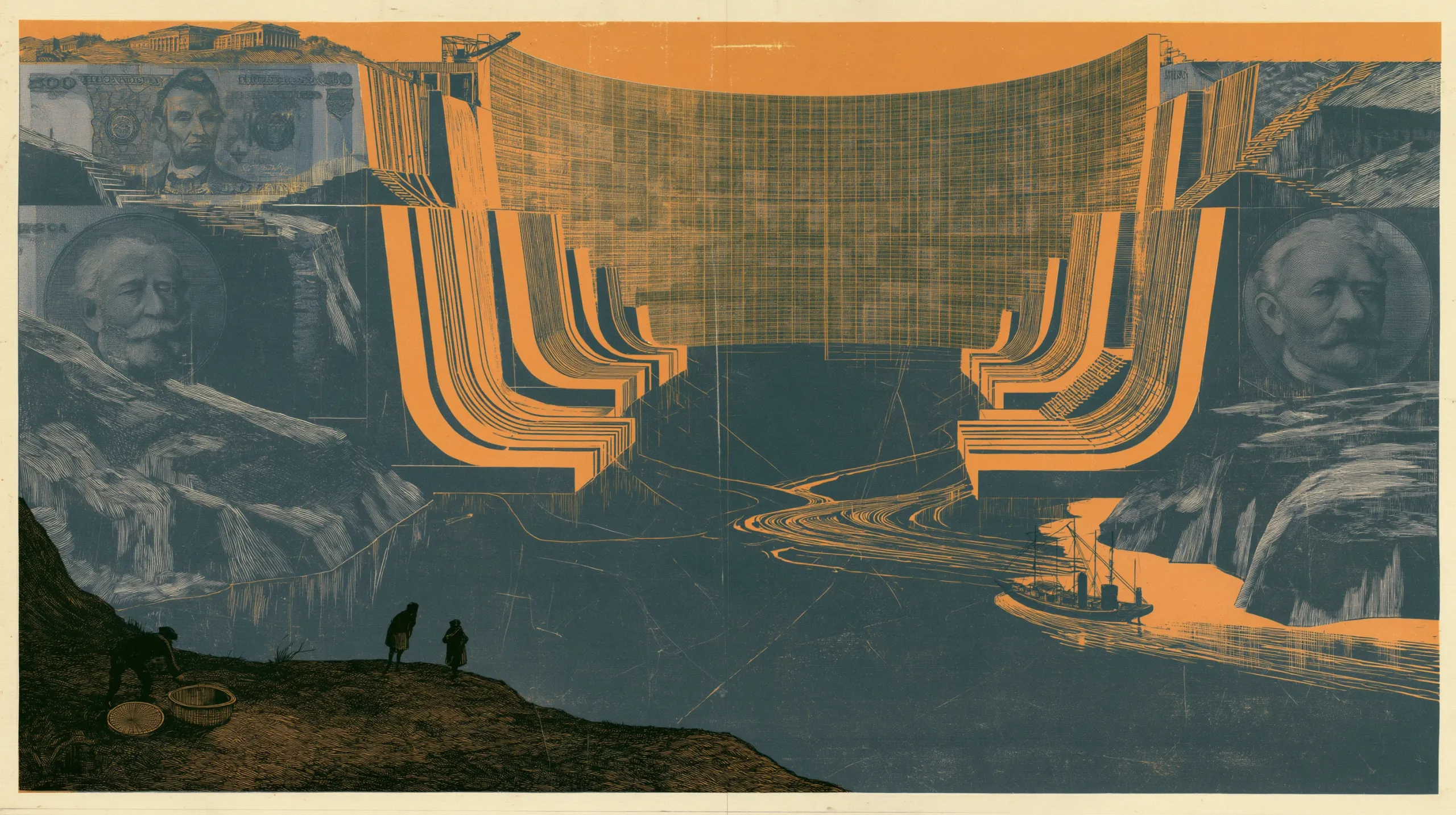
The official inflation number measures how much prices rose. It has no way to measure the price fall that never arrived, and that missing fall is a large part of what inflation costs you.
Technology cut the cost of making most of what you buy. That saving was real, and it was collected before it could reach you as a lower price. Our money system is built to push prices up, so the government and central bank create new money and credit year after year, and the new money cancels the price falls you should have received. Part of the saving reaches you as higher pay, late and unevenly. Much of the rest moves to whoever is closest to the new money, mostly people who already own the real things the new money is spent on, houses and shares above all, and the state itself. Measuring inflation against zero is what keeps the collection invisible, because zero was never where prices were headed. Under a money nobody can add to, the natural direction of prices is down. The honest baseline is that falling line, and honest inflation is the distance between where prices actually are and where productivity, our improving ability to make things, should have taken them.
Where your saving went
A photo used to cost film, processing, and postage. Now it’s free on your phone. When tools improve, the same goods take less to make. That holds for everything technology has changed the making of. It doesn’t hold for housing, care, teaching, or building. In a market with real competition, a producer who keeps charging yesterday’s price gets undercut by a rival who copies the cheaper way of making the goods and passes the saving on, so prices get pushed down toward the cost of making one more unit. Where nobody can copy it, the saving stays with the business. Say prices were left to fall that way. The saving would reach you. Wages are sticky, so at first the rate you’re paid per hour holds while your weekly shop gets cheaper, and your savings buy more year after year without you having to chase returns to get it. Where things get cheaper to make and prices fall with them, pay can drift down gently and still buy more, because the weekly shop gets cheaper by more than the pay falls. Under a money nobody can add to, that’s the natural state of a free market. Falling prices are what progress looks like when the measuring stick holds still.
That’s not what you experience, because our money can be added to. Nearly every pound in existence was created as a loan, whether that’s your mortgage, a company’s borrowing, or the government’s debt. So the money itself is made of debts, and those debts are fixed in pounds. If prices broadly fall and nothing is done to stop it, wages eventually follow them down, but the mortgage payment doesn’t shrink. The debt takes a bigger bite of everyone’s income, yours, your employer’s, the government’s.
A money system made of debts fixed in pounds can take a slow fall that comes with better tools. In that fall it’s the cost of making things that drops, and pay drifts down slowly behind it, so the money to meet a fixed payment is still there. What it can’t take is a sudden fall in the prices credit pushed up, houses first, because then the losses spread through the banks. In that fall it’s the lending that has stopped, so incomes and the house fall together and at once, and the fixed payment is hit from both sides in the same year. Houses come first because people buy them with borrowed money. And where the loan was written against a house, the house is worth less too, so the bank stands to lose more on that loan. So every time a sudden fall in those prices threatens, the system is rescued with new money, and the rescues keep getting bigger.
Between rescues, the government and central bank aim for prices to rise by about 2% a year, and they call that success. Getting there takes new money that first cancels the fall better tools would have delivered, and then adds two on top. Central banks publish why they aim there. They want room to cut interest rates in a downturn, they know wages resist falling, and they say the official measure of prices overstates the rise. Those are the reasons they give, and the debts aren’t among them.
The new money, created for the rescues and for the 2%, doesn’t land evenly. It usually enters through banks and financial markets, so the first people to receive it buy houses, shares, and bonds before prices have adjusted. Early receivers of new money benefit at the expense of late receivers. The name for this is the Cantillon effect. House and share prices jump first. Your wages adjust last, after your rent and your weekly shop have already moved. Inflation and a wage that buys less are the same event seen from opposite sides.
So when you ask where your saving went, it’s findable. It’s in the gap between what prices did and what they should have done. It’s in the house that more than doubled in pounds in the twenty years to 2020, which is where a large part of the new money went. It’s in coffee, which is vastly cheaper to grow, ship, and roast than it was decades ago, yet costs more at the till. And it’s in government spending paid for with new money rather than by a tax anyone voted on. Only after you’ve seen those steps does the short word fit. Captured. The gains were captured by the design, and no cabal was needed to plan it. Any government that allowed a sudden fall in the prices credit pushed up would preside over losses spreading through the banks. And between rescues nearly every major central bank aims at 2% for reasons it publishes. So government after government, whatever its politics, creates the money. Incentives, not villains.
Why zero is the wrong baseline
Measuring inflation from zero smuggles in the assumption that if prices didn’t move, nobody lost anything. That would only be true if the natural drift of prices were flat. Under a money nobody can add to, it isn’t. Technology pushes prices down every year, and the push keeps getting stronger, because the tools are improving faster than they did, as software and AI spread. So a year of “flat prices” isn’t neutral. Before 2008, Britain’s productivity grew near 2% a year. If that would have made your cost of living 2% cheaper and prices ended the year unchanged, the whole 2% was taken from what your money buys, and you’d never see it in any official number. At the 2% target, the take is 4%. The headline figure is only part of it. A large part of the transfer is the fall that was withheld, and no basket of goods can show you a price fall that was never allowed to happen. It’s a theft with no crime scene. What was taken never arrived in your account.
It gets worse, because the 2% target turns the measure into the goal. The system is run to make the official number read 2%, so hitting the target only tells you the system is working as designed. And every “real terms” figure you’ve ever seen is worked out in the very unit that’s being expanded. The ruler is elastic, and we’re using the ruler to check the ruler. The official basket is adjusted for quality too. When a product gets better, the statisticians mark its price down, and the name for those changes is hedonic adjustments. Those adjustments are opaque, and the rules for them are a choice of method. The basket also underweights the things that dominate a household’s life, housing above all.
The official number hides a split, and the split shows technology and new money pulling against each other. Televisions, computers, and software fell in price for decades. That’s technology’s push showing through, in the places where competition and technology moved faster than the new money. Meanwhile the things you can’t opt out of and the things people use to store value, housing, education, healthcare, kept climbing. A large part of the reason is that they’re where the new credit pools. Average a telly that got cheaper against a rent that rose and you manufacture a mild-looking 2% that describes almost nobody’s actual life.
The honest baseline
The honest baseline is productivity. Prices should fall roughly in line with our improving ability to make things, so the honest measure of inflation is the gap between measured prices and that falling line. True cost to you equals the official number plus the price falls that were withheld. So the question to ask each year becomes “how much cheaper should my life have got, and who received the difference?”
I’ll be straight about precision, because I don’t want to fake it. From inside the system, nobody can work out to a decimal what prices would have done, and that blindness is itself part of the indictment. But the direction is certain and the rough scale is visible. Output per hour of work is what the productivity figures measure. In Britain it grew near 2% a year before 2008. From 2009 to 2019 it grew between 0.7% and 1.3% a year, depending on which of the statisticians’ two measures you take. So a 2% inflation year is plausibly a 3% to 4% transfer, give or take. The tools are improving faster than they did, and you won’t see that in the official productivity figures yet. You can see the strength of technology’s push indirectly, in how hard the system pulls against it. Between 2000 and early 2018 the world added roughly 185 trillion dollars of new debt to buy roughly 46 trillion of measured growth. What it takes to hold back that push keeps growing. Nobody borrows four to get one because things are going well.
One clean way to check the ruler is to measure in a unit nobody can expand. That’s what pricing the world in bitcoin is for. Set aside whether you ever buy any. Use it as the fixed ruler for a moment and the picture inverts. The same family home that more than doubled in pounds costs far fewer bitcoin than it did, not smoothly, but unmistakably across cycles. The house didn’t change. The units did. The whole of that fall is bitcoin getting stronger as people move their savings into it. So the comparison shows you a price moving with its unit, and it can’t show you the size of the fall technology should have delivered. You don’t need the fixed ruler to accept the argument, though. The baseline stands on its own. Productivity, not zero.
The usual replies
“Official statistics already adjust for quality, so the gains are counted.”
Quality adjustments are made inside the same unit that’s being expanded, so they can’t reveal what prices would have done under a unit nobody can expand. And much of what you now get for free, maps, photos, calls, music, barely registers in the figures at all. GDP is the official measure of how much the economy produces. GDP counts paid transactions, not value, so when something becomes free it looks like shrinkage.
“If prices fell, people would stop spending and the economy would die.”
You bought a phone knowing next year’s would be better and cheaper. You’ll buy a winter coat because you’re cold now. People buy what’s useful when they need it. What does get put off is the purchase that can wait, and sometimes that’s a big one, like a car. What falls when people wait is the borrowing that would have paid for it, and life carries on. The fear, said plainly, is that you won’t shop unless we take a slice of your savings each year.
“But my TV did get cheaper, so the market clearly passes savings on.”
Yes, where technology outran the new money, prices fell anyway. That shows technology’s push is real. The question is why the same push so rarely makes it as far as your rent. New credit is a large part of the reason, because it’s channelled straight into the assets the rescues protect. Another part is that building is one of the things better tools haven’t made cheaper.
“Wages rise with inflation, so it comes out in the wash.”
Wages lag prices, and house and share prices outrun both. That ordering follows from where new money enters. Part of the saving does reach you as higher pay, late and unevenly. Against shop prices pay can catch up, late. Against house prices it hasn’t. Over a year the wash looks small. Over a generation it’s the difference between your parents buying a house on one salary and you renting on two.
Once the baseline moves, “price stability” stops being a neutral phrase. Stable prices in a world of improving technology mean the whole of the fall that technology would have delivered is being cancelled, and the saving is being collected before it can reach you as a lower price. And the paradox you live inside resolves. Almost everything is more efficient than it’s ever been, and yet most people feel poorer. Both are true. The efficiency is real, and so is the collection.