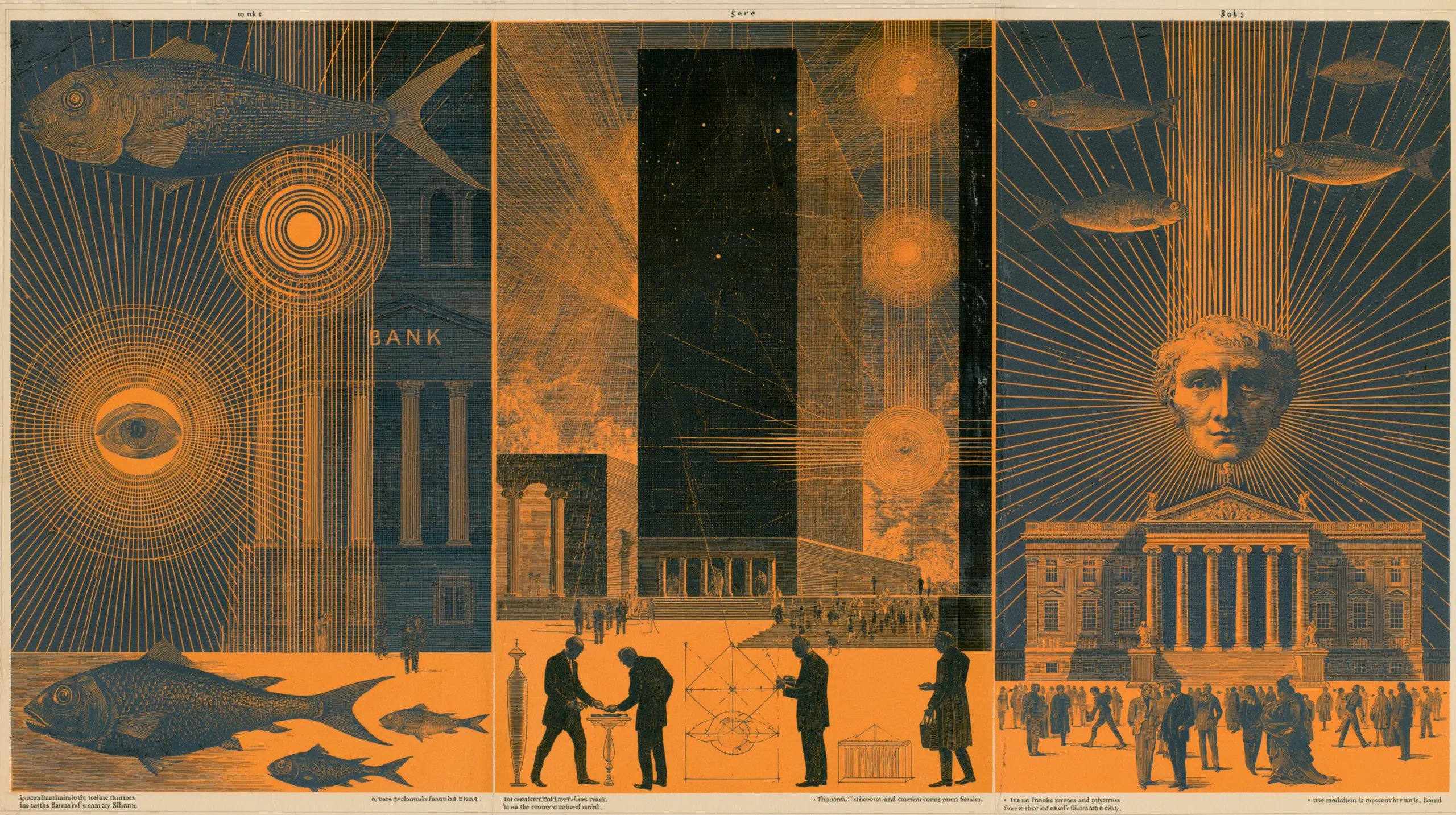
People keep asking where all the printed money goes.
The way it’s normally asked hides the answer. New money doesn’t get used up like fuel. Every new pound that exists is in someone’s hands right now. So there are two questions underneath that one. Who gets to spend the new money first? And whose pounds quietly shrink to pay for it? Answer both of those and you’ve answered it.
New money enters the economy through a few specific doors, mostly bank lending and central bank purchases of bonds. Because of where those doors are, the money lands in financial markets and property first. It pushes up the prices of the things people use to store wealth, houses and shares above all. Only later, after it has passed through many hands, does it reach wages, and by then prices have already moved. So the printed money goes into asset prices, and the value it carries comes out of wages and cash savings. It’s a transfer, and nobody posts you the bill. The bill arrives as prices.
How the money is actually born
Almost none of it is notes from a printing press. It’s created in two main ways, and the entry point decides everything that follows.
Banks create money when they lend. When a bank gives you a £300,000 mortgage, it doesn’t move some saver’s money into your account. It creates a brand new deposit that didn’t exist the day before. Most money in the economy was born this way, and in Britain most bank lending is against property. So the single biggest door for new money points straight at houses. That’s your first clue about where it all goes.
In a crisis, and well outside one, the central bank creates money directly. That’s quantitative easing [the central bank creating new electronic money and using it to buy bonds]. The Bank of England creates the money and buys government bonds from big investors such as pension funds and insurers. Those investors now hold cash they didn’t plan to hold, and in those years it paid them almost nothing. They go shopping for whatever pays more, and that means shares, corporate bonds, and property. The new money’s first stop is financial markets because that’s where it was delivered.
There’s a third door, government spending funded by borrowing that the central bank then buys up. Furlough and the Covid support went through it. That’s the one of the three that points at ordinary spending. It’s why 2021 and 2022 finally saw the weekly shop jump after a decade in which people kept asking why all the money creation hadn’t caused inflation. It had. When the new money went to markets, asset prices inflated. When it finally went to households, food and energy inflated. Supply bottlenecks pushed in the same direction.
Why first in line wins
Whoever receives new money first gets to spend it at today’s prices. This has a name, the Cantillon effect [the people closest to new money benefit at the expense of the people furthest from it]. It’s the heart of the question. The order of arrival decides who wins.
The bank funds itself at the Bank of England’s rate or cheaper and buys assets at today’s prices, and the money it creates when it lends goes into a house at today’s price. The pension fund that sold its bonds buys shares at today’s prices. The large company whose shares just rose borrows cheaply and buys a competitor, or buys back its own shares. Each hand the money passes through bids prices a little higher. The effect takes roughly a year to eighteen months to show up, and it shows up in whatever the money is being spent on. Most of the new money is being spent on assets, so asset prices move first. Wages are behind all of it, so by the time a receptionist’s pay review comes round, her rent, her food, and her energy have already gone up. She gets a 3% rise and an 8% rise in the cost of living. Nobody took a pound out of her account. The transfer happened entirely through prices, which is why nobody gets caught doing it.
Rising prices and falling real wages are the same event seen from two seats. Her wage fell behind because the new money reaches wages late. The gap is where the new money’s purchasing power came from.
Where it settles
Follow the chain far enough and the money pools in whatever people use to store wealth. Mostly houses. Banks lend new money into property, and when cash is losing value, people park their wealth in things that are hard to make more of. So a house takes on a second job. It’s shelter, plus a savings account. The extra price it carries for that second job is called a monetary premium [the part of an asset’s price that comes from people using it to store value rather than to use it]. Decades of money creation are stored in that premium. It’s a big part of why a house in Britain costs a far higher multiple of a salary than it did a generation ago, even though technology has made most goods cheaper to produce.
In the twenty years to about 2020, the world added roughly 185 trillion dollars of new debt and got roughly 46 trillion dollars of growth for it. That’s four dollars of new debt for every dollar of new growth, and each new dollar of debt produces less new output than the one before. The gap went into raising the price of things that already existed, houses that were already built, shares in companies that already traded, and into servicing the debt from earlier rounds. And there’s the question of who funds the state. In 2019 every American corporation together earned about 2.25 trillion dollars in profit, while Covid-era money creation ran at roughly 5 trillion dollars a year. You could have taxed away every dollar of every corporate profit and not matched the newly created money. Money creation is the main funding mechanism, a tax collected through prices instead of a bill, which is why it never has to pass a vote.
Since the question is where it all goes, some of it goes abroad. This is strongest for the dollar because the world holds and trades in it. Global demand for the reserve currency spreads the cost of new dollars across the savings held in them, so the pressure shows up in weaker countries’ currencies and import bills before it shows up in American shop prices. Part of the bill for a reserve currency’s money creation is paid by people who never saw any of the money.
What the order of arrival explains
Inequality stops looking like a malfunction and starts looking like the delivery route. The system moves purchasing power from late receivers to early receivers every round. Skill matters, but the gap between asset owners and wage earners widens mechanically, by place in the line. The order of arrival also explains why so many people now feel forced to invest. When money loses value year after year, a saver has to take risk just to stand still. And each crisis needs a bigger dose than the last. Technology keeps making things cheaper faster, and the debt from the previous round makes falling prices ever less tolerable to the system.
What people say back
“It paid for furlough and hospitals.” Some of it reached people directly and it mattered. But get the proportions right. Most new money still enters through the financial doors. And even the part that reached households was financed by shrinking every existing pound rather than by a tax anyone voted for.
“Wages catch up in the end.” Wages arrive late because of where the doors are, and that lag is the transfer. To catch up to prices that already moved is to arrive after the race has finished, and arriving later seldom restores what the gap took.
“My house went up, so I won.” Against a wage earner, you did, and that gain is real. What you can’t easily do is spend it. You’d have to sell and leave the housing market altogether, because you still need somewhere to live and the house you’d move to inflated with it. Measured in houses you’re standing still, and your children buy in at the higher multiple of a salary that your gain is made of. The number rose. What you can spend, while you still need a roof, mostly didn’t.
“Then tax the rich and claw it back.” That attacks the symptom while the tap stays open. As long as new money keeps entering through assets first, asset prices outrun taxes, and the next round rebuilds the gap.
The ruler moves too
The reason this is so hard to see is that we measure everything in the unit being created. When the price and the ruler both move, you can’t tell what happened. Flip the measurement to something nobody can make more of at will, and the picture inverts. Bitcoin is the first money that lets you flip it. Priced that way, the trend in houses and shares has been down for years, which is the direction you’d expect technology to push. So, the question. The printed money went into the numbers. The value went from wages and savings to whoever stood closest to the door. And “everything going up” was mostly the ruler shrinking.