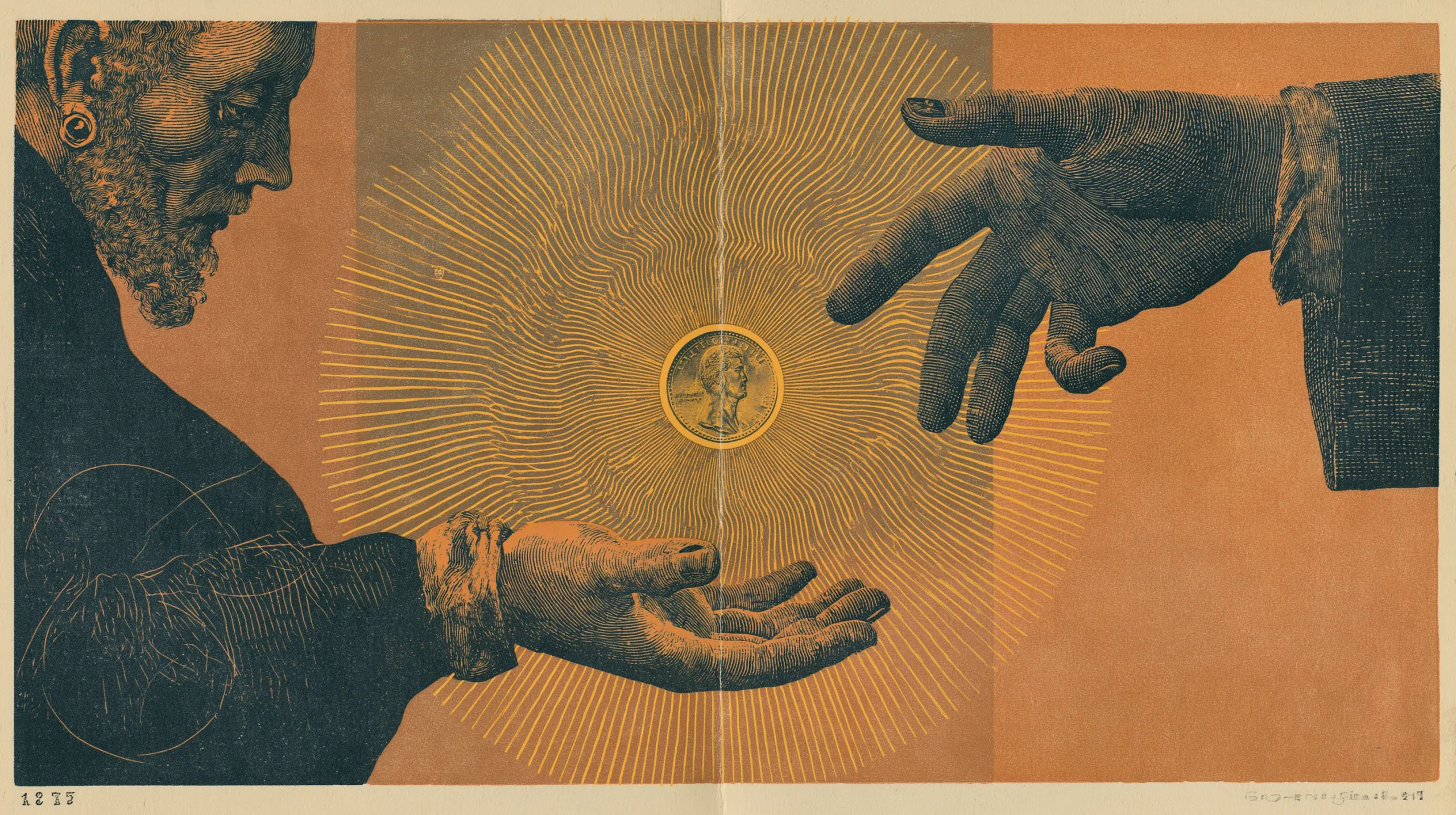
The number on your payslip [your nominal wage] went up. What that number buys [your real wage] mostly didn’t, and in plenty of years it fell. And there’s a second layer almost nobody accounts for. Technology should have been cutting your cost of living every year you’ve been working. So the honest comparison is your rise against the falling prices you were supposed to get and never did.
Two forces are fighting over your payslip
Every year our tools improve, so the same goods and services take fewer people, less energy, and less time to produce [productivity]. Competition then pushes prices down toward what things cost to make. You can watch this force operate wherever money’s influence is weakest. The phone in your pocket swallowed a camera, film, a map, a music collection, and long-distance calls, and the price of all that capability keeps collapsing. In a market with honest money [money nobody can create more of], that force works on everything, and pay that merely stays flat buys a little more life each year. That’s a real pay rise that never needed a meeting with your boss.
Now the counterforce. Our money is created through lending, and most debt is fixed in pound terms. If prices broadly fall, the income that pays those debts falls too. Company revenues and tax receipts drop almost at once. Pay follows slowly, which is why falling prices would leave you better off for a while. The debts don’t move at all. A mortgage, your employer’s loan, and the government’s borrowing are the same number of pounds whatever prices do, so the whole pile gets harder to carry, and if that runs long enough, defaults cascade through the banks. So the system can’t allow prices to broadly fall. The government and central bank create new money and credit to keep prices rising by about 2% a year, and that rate is an explicit target.
Why you’re always at the back of the queue
That new money doesn’t reach everyone at once. It enters through financial markets and cheap borrowing, so it lifts house prices and shares first, pulls rents up close behind, and reaches wages last [the Cantillon effect, whoever gets new money early spends it at old prices, and by the time it filters to you, prices have already moved]. Wages are the slowest prices to move [wage stickiness, pay is renegotiated maybe once a year, after the cost rises have already happened]. So your rise is compensation for last year’s price rises, paid late, while next year’s are already in the post. You keep running to stand still. The rise that felt like progress was catching up, not getting ahead.
You can watch the counterforce at full speed too. When Malawi’s currency was devalued by about 44% overnight, prices jumped across the board, and no one got a 44% pay rise to match. Your version runs at about 2% a year instead of 44% in one day, slow enough to pass as normal.
Why it feels worse than the official number
The inflation figure is an average over a basket. Cheapening electronics pull the average down. The costs that dominate your actual life, housing above all, run hotter. Supply is tight, but the timing and size of the rises track new credit. Broken money turns houses into savings accounts and the credit flows straight into them. Add the hidden price rises. Same sticker, smaller portion, thinner quality, slower service [shrinkflation]. So a rise that “beats inflation” on paper can still lose to your lived costs. That’s the gap between the statistics saying you’re fine and the feeling at the till that you’re not.
The part nobody counts
Even if your rise exactly matched your lived costs, you’d still have been short-changed, because the baseline is wrong. Don’t measure inflation from zero. Measure it from where prices would have gone without interference. Say better tools would have cut prices by 3% in a year, and instead prices rose 2%. Those numbers are an illustration, not a measurement. On them, about 5% of your purchasing power moved somewhere else that year, without a line item anywhere. You worked just as hard. Technology made things cheaper to produce. The saving never reached you. It went into keeping the debt pile serviceable, and it surfaced in the prices of assets owned by the people ahead of you in the queue. That’s why the share of the house your landlord owns outright grew while your deposit target ran away from you. And why you’re pushed to become an investor, taking risks you never wanted, just to stand still.
Reasons to think your rise was real
“Wages do catch up over time.”
They chase, they don’t catch. The lag is the mechanism, and it compounds. A lag of a few percent a year, held for twenty years, can be the difference between owning a home and renting one from someone who got the new money first.
“Official real wages look fine.”
The basket underweights the thing you’re actually saving for, a home, and gives full weight to the things technology already cheapened. Your life isn’t the basket.
“We need 2% inflation or people stop spending.”
You still bought a phone knowing next year’s would be better and cheaper. People buy what’s useful when they need it. Falling prices from productivity are progress. The dangerous deflation is a debt collapse, and what makes it dangerous is the debt, not the cheaper goods.
So inflation is wage deflation. They’re the same event seen from two sides, and the pay rise ritual is how the system passes its own price rises back through your payslip a year late and calls it a reward.
Once you see that a bigger number isn’t a rise, the next question asks itself. What would pay look like measured in a unit nobody can create more of? That question is the door. Flat pay in a money that can’t be diluted is a rising life, because the falling prices finally get through to you.