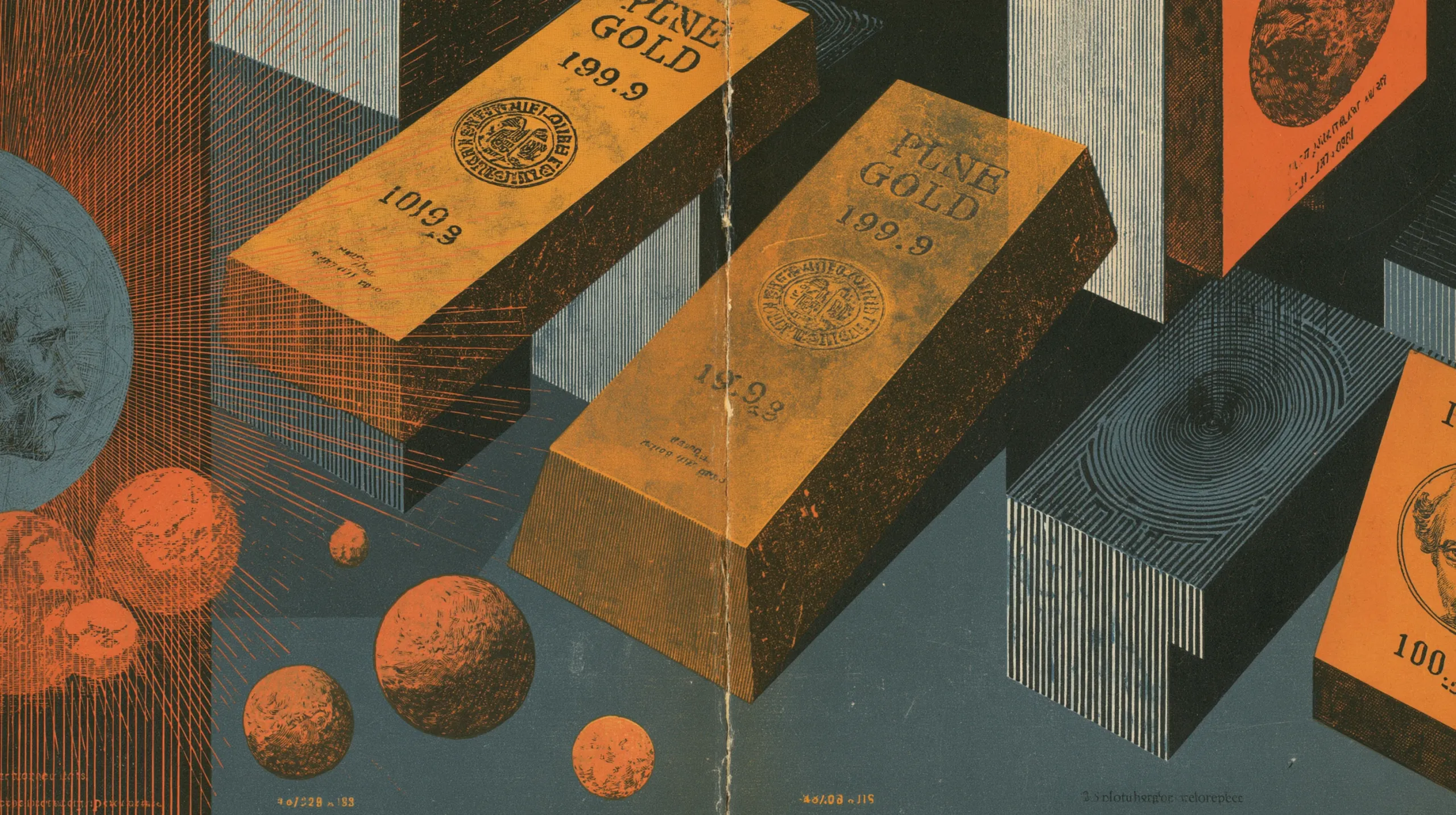
We had sound money with gold, and we lost it. Gold’s scarcity never failed. Its custody did. The metal stayed scarce the whole way through. What failed was everything people had to build around the metal to use it. The mints, the vaults, the paper receipts, the banks, and finally the central banks. Collapse after collapse of the gold standard was a failure of that custody layer, not of the asset. That distinction tells you where the next attack comes from.
Why gold needed a custody layer at all
The failure is built into the metal’s physical properties.
Gold is heavy, slow to move, and hard to verify in bulk. None of that matters when you’re paying someone in the same room. But money means paying someone in another city or another country, in amounts too big for coins. Shipping bars is costly and risky, and when they arrive the receiver can’t easily check what they’re made of, because testing purity is a specialist job. So from the beginning, using gold beyond the same room forced trusted parties into the middle. Mints to standardise coins, vaults to store metal, banks to move value on paper instead of in metal.
Then the sequence runs, and each step is rational, and each step hands over more control.
You deposit gold in a vault and get a paper receipt. The receipt is light, easy to hand over, and divisible, so receipts start circulating as the actual money. People hold promises. The bank holds the metal.
The banker notices most of the gold never leaves. So they issue more receipts than they have metal and lend the extra ones out, earning interest on money they created [fractional reserve, keeping less metal on hand than the receipts issued against it]. A banker who declines that trade loses ground to one who takes it, so competition pushes reserves lower and lower.
At that point, the money people use every day is no longer bound by the scarcity of gold. The metal’s supply grows by a small, slow percentage each year. The supply of receipts grows at whatever pace bankers can issue them. The scarce asset has been separated from the circulating money.
Eventually doubt arrives, everyone redeems at once, and the bank can’t deliver. Runs repeat across banks and decades. The political fix for repeated runs was a lender of last resort [a central bank that creates money to rescue failing banks], and gold consolidated out of many private vaults into a few national ones. Custody centralised as the cure for the instability that custody itself created.
Once the metal sits in one place and the population holds paper, the rules change by decree. Countries suspended convertibility [the right to swap a paper claim for the metal behind it] in 1914 to print for war. Britain left gold in 1931. In 1933 the United States ordered citizens to hand their gold to the banks. On paper, that order reached every private holding in the country above a hundred dollars in coin a person. In practice, most of what the state collected came through the banks, because that’s where the gold already sat. The state almost never prosecuted anyone who kept coins at home, and it didn’t need to. The order carried a fine of up to ten thousand dollars and up to ten years in prison, and coin after coin came in from households without an official ever knocking. A law can reach a mattress. Searching millions of them is a different job, and the state never had to do it, because the threat did most of the work and custody had already built the choke point. In 1934 the state devalued the dollar against the gold it now held, raising the official price from $20.67 an ounce to $35, so every remaining paper claim bought roughly 40% less metal overnight. The post-war Bretton Woods agreement then narrowed convertibility to foreign central banks only, so one country’s vault effectively backed the world. In 1971 the United States suspended even that, and the last link snapped.
A verification failure ran underneath it all. At no point could an ordinary holder of claims verify the reserves. Gold has no public, continuous audit. You trusted the bank, then the central bank, then a government’s word. So the whole gold system stood on trust in the people holding the metal, not the metal itself. That trust is the surface that got attacked, again and again.
You don’t need villains for this story. Plenty of the individual steps were deliberate. Someone signed the order in 1933 and someone set the new price in 1934. What nobody designed is the pattern that kept producing those steps. Each one was the locally sensible move given the incentives in front of the person taking it, and the failure is in the arrangement rather than in anyone’s plan for it. It was not harmless. Devaluing a currency makes every saver’s money buy less overnight, without their consent and without a vote, and nobody has to intend that for it to be a real loss. Structure explains why it kept happening. It doesn’t make it fine.
Separating the two properties cleanly
Scarcity is a property of the asset, and it answers one question. How hard is it to make more of the thing? Gold never lost that property, because mining stayed expensive.
Gold’s supply did grow. Miners dig up new metal every year, and they dig up more of it when the price is high enough to pay for the work. Between 1900 and 1971 the amount of gold sitting above ground roughly tripled. Someone holding a coin in 1900 owned a smaller share of all the gold in the world by 1971, without doing anything wrong and without anyone taking anything from them. That dilution was real and slow.
At its fastest, in the gold rushes of the 1850s, the biggest supply shock gold ever had, its stock grew by perhaps 2 or 3% a year. Set that beside 1934, when the dollar was cut against gold by about 40% in a single announcement, or 1971, when the right to swap dollars for metal was cancelled on a Sunday evening. One of those is a slow leak you can measure. The rest is someone reaching in and changing the number. They’re not the same problem, and only one of them killed gold as money.
The mine was a leak. The vault was the failure.
Custody is a property of the system around the asset, and it answers a different question. Who stands between you and the thing, whose promise are you actually holding, and who can change the terms? That’s where the failures happened. Fractional issuance diluted the claims. Suspension dishonoured the claims. Devaluation rewrote the claims. The metal was untouched throughout.
Scarcity protects you against dilution of the asset. It can’t protect you against dilution or repudiation of claims on the asset. And a money whose physical nature forces claims to do the daily work will, in practice, be the claims. Gold in your hand had no counterparty [nobody else’s promise has to hold for your asset to be good]. Gold as a working monetary system was almost nothing but counterparty. Its scarcity stayed in the metal while its usefulness moved into the claims, and no scarcity rule stood behind the claims.
“We tried sound money and it failed” is the standard dismissal of trying again. Spell it out and it says something narrower. We tried scarce money that you could hold and roughly check yourself in small amounts, but not across a whole economy, and the custody layer that filled that gap is what failed. Which hands you the specification for any successor. Scarcity alone was never enough. You need scarcity, plus the ability for ordinary people to hold the asset itself without a promise in between, plus the ability to verify the whole system cheaply, plus rules that nobody can rewrite by owning enough of the thing itself.
That fourth one only holds if something stronger than wealth stands behind it, and in bitcoin two things do. The rules are enforced by every node. A block that breaks them, one that creates extra coins, say, is rejected by every node that sees it, no matter how many coins the person who built it holds. The record is defended by energy. Rewriting it means buying enough energy and hardware to redo the work faster than the rest of the network combined, and then paying for that every day you want the rewrite to stick. Neither defence bends to wealth. Owning more coins doesn’t buy a vote at the nodes, and it doesn’t cut the energy bill by a penny. A design where the biggest holders decide the rules fails this test, because the rules become whatever the biggest holders want. That’s where gold’s system arrived by a slower road. Gold in the hand offered scarcity. Gold as a system, once a whole economy ran on it, could not offer the other three. A new gold standard wouldn’t fix that, because it would re-install the same custody layer and ask it to behave this time.
Still, the leak tells you what gold could never offer. Gold is hard to make more of. It isn’t impossible to make more of. Its scarcity rests on two things that can change. Where the ore is, and what it costs to get it out. Both are facts about the physical world, not rules. Every time the engineering improves, a bit more gold becomes worth digging up. People now talk about mining metal from asteroids. Nobody has done it beyond samples, two well known companies tried and folded, and the total amount of asteroid material ever brought back to Earth would fit in a teacup. But the argument doesn’t depend on whether it works, because even if it works it arrives over decades, through rockets and refineries and capital, on a schedule anyone can watch.
Gold’s scarcity was always a bet on the frontier moving slowly.
A bet isn’t a rule. With bitcoin there will only ever be 21 million, and there’s no price at which more appear, no discovery that changes it, and no amount of energy or money that buys an extra one. Gold gives you scarcity that no government can change by decree, but the ore and the engineering can still change it between them. Bitcoin’s scarcity rests on a rule instead, and the only way past a rule is to get the people who enforce it to give it up. Nobody can buy that.
What that failure teaches us to watch for now
The scarce asset’s supply is the hard path, so the attack doesn’t go there. It goes at the layer where people hold and use it. Bitcoin’s supply is checked by every node [software anyone can run that verifies every transaction against the rules], and changing it would need the network to agree to create more of it than the rules allow, so the pressure moves to custody, claims, and narrative. Gold’s playbook, re-run one layer higher.
1.Custody concentration
What share of coins pools inside a few exchanges and funds? An ETF [a fund traded on the stock market that holds bitcoin for you] puts a custodian back between you and the asset, since the fund’s custodian holds the coins and you hold a claim on the fund. As a bridge for access it’s useful. As a destination it rebuilds the choke point, because a large regulated pool can be pressured, gated, or lent out in ways the people holding its shares never see.
2.Claims outgrowing coins
Watch for bitcoin IOUs and derivatives [contracts whose value tracks bitcoin, typically without moving actual coins] doing more of the daily work than coins themselves. Receipts beyond reserves is the exact move that broke gold, and paper claims can blur the visible price for a while.
3.The bailout
This one you can read off a single event. Leverage built on bitcoin tends to blow up fast and stay contained, but only if failures are allowed to fail. The moment a failing firm that issued more bitcoin IOUs than it holds coins gets rescued instead of liquidated, the old dynamic is back, because rescue lets fractional claims persist instead of dying young. Gold’s claims layer survived issuing more claims than it could honour because the state kept absorbing the losses. And what would a rescue be made of? Nobody can print bitcoin to cover a bitcoin shortfall, so any bailout has to be paid in the state’s own currency, created for the purpose. That buys the failing issuer time and costs the currency, because the rescue is new money and everyone holding that money pays for it. The Bitcoin ledger doesn’t move at all. So a state can still do it. Each rescue strengthens the case for the thing the state was trying to contain.
4.The “asset, not money” split
Watch rules and stories that welcome bitcoin as an investment inside custodial wrappers while discouraging its use as money. “Hold the ETF, spend the stablecoin, self-custody is dangerous.” A stablecoin is a company’s token that tracks the dollar or the pound, so that slogan keeps your spending on custodial rails too. That was gold’s endgame. You could own exposure, you just couldn’t use metal as money. A rule that raises the cost of holding your own keys or paying peer to peer is the same move again, whatever reason is given for it.
5.Redemption friction
Gold’s convertibility died in steps, not all at once. The modern equivalent is withdrawal getting slower, costlier, or treated as suspicious. Watch whether moving coins from a custodian into your own keys stays cheap, fast, and normal.
The difference from gold is the whole point of the design. Gold’s ordinary holders had no countermove that let them keep using gold as money. You could keep coins in a drawer, and plenty did, but the moment you wanted to pay someone in another city you were back in the custody layer. You couldn’t verify a vault from your kitchen table or carry a tonne of settlement across a border. This time the countermove is personal and cheap. Hold your own keys and no custodian’s promise stands between you and the asset. Run a node and you personally audit the supply every ten minutes, which no gold holder in history could do. Use it as money and the economic weight stays spread across the network instead of pooling in a few hubs. That third one is a condition. If bitcoin is only ever saved and never spent, everyday payments keep running on custodial rails, the economic weight and the fees pool in a few large hubs, and those hubs become the same choke point the vaults were. Held but never spent, it fails. That doesn’t mean paying for your coffee in bitcoin tomorrow. Fiat rails are a reasonable bridge while the payment layers mature. The destination still has to be money people spend. The way gold failed can happen here too, but for the first time avoiding it is a choice individuals can make rather than a favour custodians must grant. That’s also why the outcome depends on more than the code. It depends on whether enough people make that choice.
Where this argument gets attacked
“Gold worked for centuries, so the design was fine.” It worked until it scaled, and scaling it ran the same sequence again and again. Receipts, fractional issuance, runs, rescue, centralisation, decree. Before paper, the route was shorter and the end was the same. The mint held the standard, and rulers cut the metal content of the coin while keeping its name. One failure is an accident. The same failure across centuries and continents is a structural property of the design.
“Then just go back to a gold standard.” Ask what that requires. Every major country has to agree to it at the same time, and each one has to trust that the others really hold the reserves they claim, in the amounts they claim, checked by someone everyone accepts. That’s a great deal of trust to ask for between governments that currently agree on very little. And the moment one of them is suspected of overstating its reserves, the argument stops being a technical one about accounting and becomes an argument about whether a country’s money is real. Those arguments have ended in force before now. Bitcoin asks for none of that agreement. Nobody has to trust a stated reserve, because anyone can check the entire supply from a laptop, and no country has to say yes before a person can start using it.
“The state will just do 1933 to bitcoin.” 1933 worked because the gold was already sitting in the banks, and because the penalty attached to the order was heavy enough that gold came out of drawers without the state having to ask twice. The order was written to cover privately held gold too, and that part was barely enforced, because chasing dispersed holdings costs more than it collects. The state took the choke point, which was cheap, and it reached into the mattresses too, not by searching them but by making it frightening to keep one shut. Facing tens of millions of dispersed key-holders across many jurisdictions is the same trade for a government, only far worse, because the cost of seizure explodes while the yield from each one shrinks, and many of the holders are outside its reach entirely. States can still lean on exchanges and custodians, though, which is exactly why custody concentration is first on the watch-list.
“Derivatives suppressed gold’s price and will do the same here.” They can mute the visible signal for a time, and they did with gold. But paper never stopped the metal being metal, and it can’t stop bitcoin settling. The difference is that a bitcoin claim-holder can take delivery within hours by withdrawing to their own keys, whereas a gold claim-holder practically couldn’t. Every withdrawal shrinks the suppression lever. Gold had that escape too, but only a few players could use it. Foreign central banks redeemed dollars for metal through the 1960s and drained the American stock. That’s why the window shut in 1971. With gold, the right to take delivery had narrowed to a handful of governments, and one announcement closed the only window, for everyone, at once. With bitcoin, that right belongs to anyone holding coins at a custodian, not to a shortlist of states. Hold a share in a fund instead and you have no right to take delivery at all, which is why custody concentration heads the watch-list. An announcement can still freeze withdrawals at this custodian or that one. Redemption friction is on the watch-list for that reason. What no announcement can close is the network the coins withdraw into.
Gold failed because using it beyond the same room required trusting custodians, and custodians turned a scarce asset into an elastic promise. So watch anything that moves bitcoin’s daily usefulness back into promises.