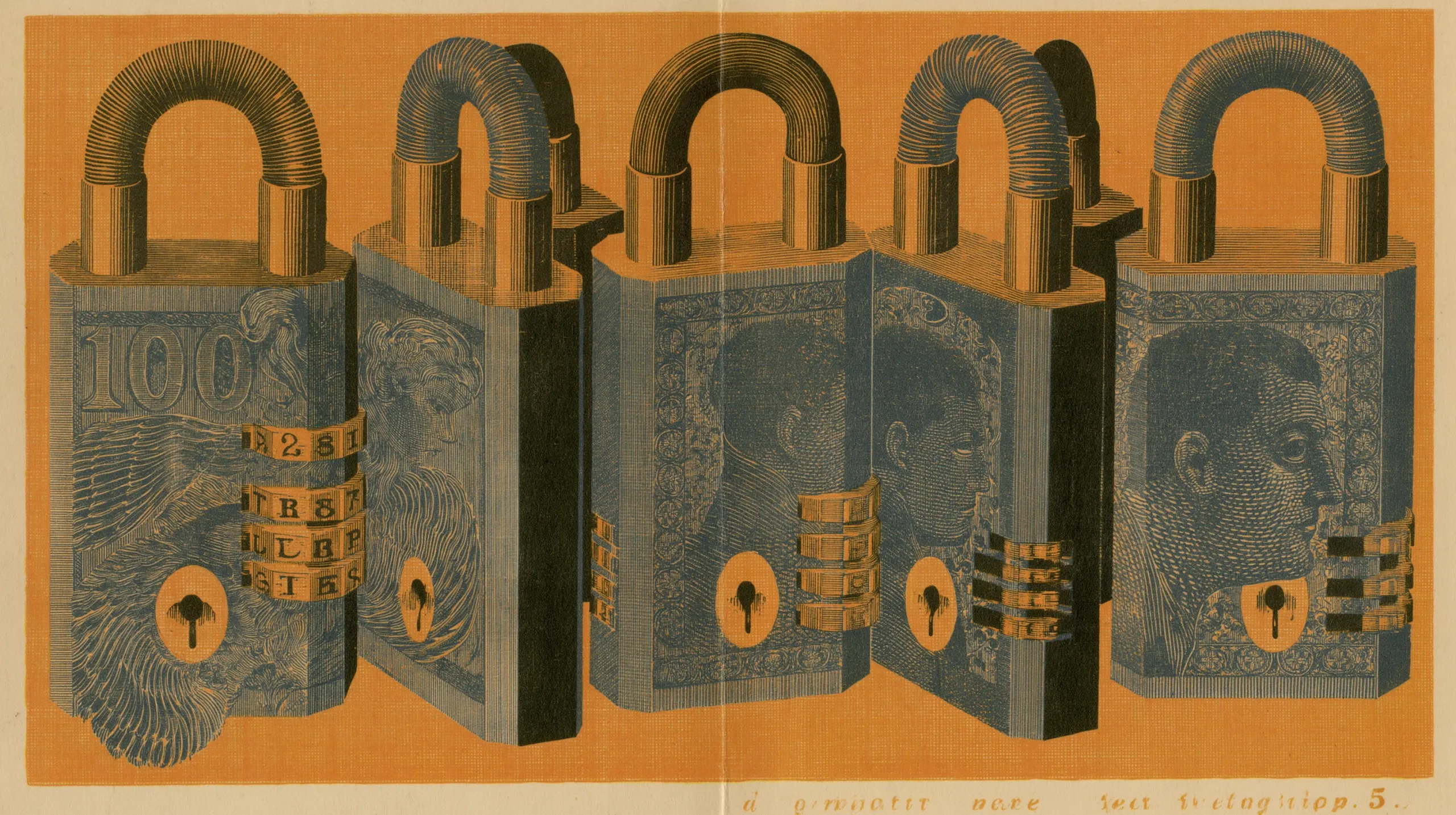
Say we had to design money that nobody, however powerful, could make more of. It would need certain properties, each one there for a reason. Then the question is what, if anything, satisfies the list.
You can’t get “nobody can make more of it” by writing it down. A promised supply limit is only as fixed as the people keeping the promise, and monetary history is mostly a list of those promises breaking. Rome put less silver in its coins. Governments on the gold standard stopped paying out gold for their paper when the gold ran short against the claims on it.1 Every fiat currency [government money whose supply and rules are set by policy] has an institution whose job is to manage the supply. So the design brief has to go past “pick something scarce” to “remove every route by which the most powerful actor in the room can reach the money”. Do it that way and the properties stop being a wish list. Each one exists to close a specific route of attack.
Why the brief matters at all
Money is the record of work you’ve already done. A teacher in Leeds saving £300 a month is storing hours of her life to spend later. When someone makes more of the money, they move purchasing power from everyone holding it to themselves, without asking, because the new units buy real things before prices adjust. So this question decides whether saving works at all, and whether the gains from technology reach people as lower prices or get absorbed on the way through.
The five routes, and the properties that close them
Route 1. Issue more units
Kings did it with a mint, central banks do it with a keyboard. The close is brutal. There’s no issuer at all. The supply schedule has to be an automatic rule that’s nobody’s job to administer, because any administrator, however constrained or well meaning, holds a lever, and levers get pulled in emergencies. The rule also has to hold against effort in what it issues. If ten times the effort bought extra coins, a state could outspend everyone. So production has to get automatically harder as more effort chases it, and neither the total nor the amount that comes out at each step moves, no matter who shows up with how much power. The dates drift by months, because each period’s difficulty is set from the period just gone.
Route 2. Change the rule
A fixed rule enforced by a small committee is fixed only until the committee finds it inconvenient. That’s what happened to the promise to pay out gold, in 1933 and 1971.2 The close is distributed enforcement. Every user must be able to hold the complete rulebook and automatically reject money that breaks it, and anyone must be free to join as an enforcer with no gatekeeper deciding who qualifies. Then changing the rules requires near-universal voluntary agreement, because a powerful group that “upgrades” the rules alone just creates a separate currency the rest of the network ignores.
Route 3. Multiply claims instead of money
You don’t need to counterfeit gold if everyone’s gold sits in your vault and trades as your paper. The claims become the money, and claims can be printed. Two properties close the route together. The money must be a bearer asset [something you own by holding it, with no custodian in between], so you don’t need a custodian. That’s self-custody. You hold the money itself, not a claim on someone who holds it for you. And verifying the real thing has to cost nearly nothing, because cost is what decides how many people can check. Cheap checking only leaves dilution nowhere to hide while enough people are checking, and the main risk is people stopping. If verification is expensive, it centralises into a few trusted auditors, and the auditors become the new vault.
Route 4. Rewrite the record
Purely digital money has a special problem, because digital information copies for free. Something physical has to anchor it. Writing the ledger has to cost real energy while checking the ledger stays nearly free. Then rewriting history means redoing the accumulated work faster than the rest of the network combined, and cheating becomes a losing trade rather than a forbidden act. Systems that skip the physical cost and let the largest holders write the record haven’t removed the committee. They’ve rebuilt it, weighted by wealth.
Route 5. Seize it
Scarcity you can confiscate is scarcity that serves whoever holds the guns. In 1933 the US called in private gold, and the vaults made enforcement easy.3 The close is money you can hold as information, together with holders spread widely. A memorised seed [the words that are the keys to the money] removes the vault, so there’s no single store to raid. Mass seizure becomes far costlier, not impossible. You can raid a vault once. You can’t raid millions of memories.
There’s a sixth, quieter requirement. The money must be practical at every scale. It has to be divisible enough to buy coffee, portable enough to settle across an ocean, and durable forever. Practicality is a security requirement, because impracticality reopens route 3. Gold’s physics is the proof, because gold couldn’t be checked or moved cheaply, so people wrapped it in paper and parked it in vaults, and the wrapping is where it was captured. And a layer [a faster system built on the money as its base] that supplies that practicality only closes the custody route if the holder can get back to the base without anyone else having to act. A federation that needs a majority of its guardians to sign, and a mint that issues tokens it has to be trusted to redeem, supply practicality by putting a custodian back in between, so they don’t close it.4
And these properties interlock. Scarcity without distributed enforcement is a promise. Enforcement without cheap verification decays back into trust. Verification without self-custody just documents how your custodian is diluting you. Self-custody without divisibility drives people back to custodians. Take any one away and what’s left stops being money nobody can make more of, even when the thing itself stays scarce.
The audit
Fiat fails by design. A money loaned into existence has to keep its stock of money and credit growing, or past debts can’t be serviced. That’s the design. It doesn’t require measured consumer prices to rise every year, because the growing stock pushes them up while technology pushes them down, and the published figure is the net of the two. Money pegged to a fiat currency, like a dollar stablecoin, inherits the design. Fiat is the thing the brief exists to escape.
Gold is the near miss, and the most instructive failure. It very nearly passes route 1, because you can’t will gold into existence. You have to dig it up at real cost. What it lacks is the automatic brake. Nothing holds gold’s issuance to a schedule, so more effort still means more gold. But it fails cheap verification and it fails portability. Divisibility isn’t one of its failures. Gold coin circulated at retail in Britain before 1914, so the metal could be split small enough to spend.5 What couldn’t be split was the bar that the settlement system used. Those two failures forced gold into vaults and paper claims, and the claims were multiplied and the rules changed. In practice the metal stayed scarce. What broke was custody, and once the paper was doing the work of money, the money’s supply broke with it. A physical money leaves no way out of custody at settlement scale, so intermediaries are forced.
Most other cryptocurrencies trade away distributed enforcement by choice. They do it to gain speed or features, and a foundation that can pause or patch the chain is an issuer in waiting. Stake-based systems let the largest holders write the record. And anyone can copy Bitcoin’s code tonight, which proves the cap was never what made it scarce. The five routes on their own don’t separate Bitcoin from a copy whose ledger also costs real energy to write. What separates it is accumulated work and the size of the network standing behind the rules. The unit is scarce because one specific network exists, made of holders, accumulated energy history, and many operators who each refuse blocks that break the rules. A copy starts with none of that. Those operators mostly run one rule-checking program, and a flaw in that program would pass almost everywhere at once.6 So what the network supplies is many independent refusals rather than many independent checks of the rules themselves.
A central bank digital currency [money the central bank issues direct to the public, on its own ledger] is the brief inverted. Every route is held open, plus programmability, so the issuer decides how much money exists, and what your money is allowed to do becomes a setting on the issuer’s own ledger. Two published designs promise not to set it. A promise isn’t the same as not having the switch.
Which leaves one artefact. Bitcoin is the list, item by item. No issuer, just a schedule that stops at 21 million coins, enforced by everyone who runs a node [software that checks every transaction against the rules].7 Production that gets harder as more effort chases it. A rulebook a home computer can enforce, and a supply anyone can audit in full. A bearer asset held as twelve words.8 A ledger anchored to energy through proof of work [spending real electricity to write each block, so faking history costs more than it pays]. Divisible to a hundred million units per coin, and settled globally in minutes, with faster payment layers on top.9 Durable in the way information is durable, because many independent nodes each keep a full copy of the record.
Bitcoin satisfies the list only if it stays decentralised and secure. The design closed the five protocol routes, and seventeen years of attack haven’t opened one. In 2010 a bug let one block create coins beyond the schedule, and the network closed it within hours.10
The biggest route still open in the near term is social. A break in the maths that protects the coins, such as a practical quantum attack, is a separate and more distant route that the network can meet with a consensus upgrade [a rule change adopted by near-universal agreement]. If most coins end up pooled inside a few regulated custodians, and most people keep measuring their life in pounds, the old lever gets rebuilt one layer up, paper claims on bitcoin the way there were paper claims on gold. A digital bearer money also collects in custodians, and while a custodian is honouring withdrawals the holder can leave. Once the custodian stops honouring them, the holder is a creditor and not an owner.11 The live question is whether enough people hold their own keys and use the network, because custodians centralise the money only to the extent people don’t. Closing the routes is necessary, and it isn’t the whole of what makes a money. A money also has to be taken in trade. If bitcoin is only ever saved and never spent, the network fails. The defence is people holding their own keys, running nodes, and actually using the thing. So the design guarantees nothing. It makes the guarantee available, and keeping it is a job.
Arguing back
“Just run fiat with better people.” Incentives beat intent. Whoever holds the lever eventually pulls it, usually in an emergency, almost always described as temporary, and no committee can know enough to set the price of money, which is what an interest rate is, anyway. The fix is removing the lever, not auditioning better hands for it.
“The energy cost is waste.” The cost is the mechanism. It’s what anchors the record in physics, because rewriting the record means outspending the rest of the network combined. Strip the cost out and you’re back to a database run on goodwill.
“Developers could just change the cap.” Developers propose, nodes dispose. A cap change without near-universal agreement creates a minority coin the market can ignore, and the people who’d have to adopt the change are the same people it would rob. The overlap is what does the work. Where someone else holds your coins and picks your rules, you can be taken from without being one of the people who adopt.
The requirements weren’t invented after Bitcoin. The cypherpunks [the people who set out to build private digital money out of cryptography rather than institutions] tried and failed many times at digital money over two decades, and they weren’t alone. The earlier attempts at digital cash taught what didn’t work, and the design answered those known weaknesses. DigiCash, a company that issued, died with its issuer. E-gold, whose gold sat in a custodian the state could reach, died on routes 3 and 5.12 The wider cypherpunk community built privacy tools, and it also anticipated the need for money separate from the state. Grouping the requirements into five routes came later. Bitcoin is the first artefact that closed all five routes at once. The question that matters most long term is whether it stays decentralised and secure. The rest follows from that, and from whether it comes into use as money rather than only being held.
And kept decentralised and secure, the design buys one thing. Not a number that goes up. A ruler that can’t stretch. Measured against a fixed ruler, technology finally reads as what it’s always been, prices falling as we get better at making things.13 That’s the rest of the thesis.
Sources 13
What this essay rests on, as checked on 12 November 2026.
- 1 Oxford University Press (Oxford Academic), Journal article, “Danger to the Old Lady of Threadneedle Street? The Bank Restriction Act and the regime shift to paper money, 1797–1821”: “The Bank Restriction Act of 1797 was the unconventional monetary policy of its time. It suspended the convertibility of the Bank of England's notes into gold, a policy that lasted until 1821.” UK Parliament, Hansard, House of Commons debate, Gold Standard (Amendment) Bill, 21 September 1931: “Sub-section (2) of Section (1) of the Gold Standard Act, 1925, shall cease to have effect”; “during the last two months, we have lost in gold and foreign exchanges a sum of more than £200,000,000”, 21 September 1931. The page covers only the September 1931 suspension and prints nothing on 1914. Richard Nixon, American Presidency Project, Address to the Nation Outlining a New Economic Policy: “The Challenge of Peace,” August 15, 1971: “I have directed Secretary Connally to suspend temporarily the convertibility of the dollar into gold or other reserve assets, except in amounts and conditions determined to be in the interest of monetary stability and in the best interests of the United States.”
- 2 Federal Reserve History, Essay, “Roosevelt's Gold Program”: “During the first phase, in the spring and summer of 1933, the Roosevelt administration suspended the gold standard.” Before that, holders could “convert those dollars into gold at a fixed price of $20.67 per ounce of pure gold.” Federal Reserve History, Essay, “Nixon Ends Convertibility of U.S. Dollars to Gold and Announces Wage/Price Controls”: “On the evening of August 15, 1971, Nixon addressed the nation on a new economic policy”; “The first order was for the gold window to be closed.”
- 3 Franklin D. Roosevelt, The American Presidency Project, Executive Order 6102, Forbidding the Hoarding of Gold Coin, Gold Bullion and Gold Certificates, 5 April 1933: “All persons are hereby required to deliver on or before May 1, 1933, to a Federal Reserve Bank ... all gold coin, gold bullion and gold certificates now owned by them”; dated April 5, 1933.
- 4 Fedimint project, Project documentation, “how federations work”: “a threshold of t signatures is required to move funds, where t is a majority”; “No single guardian — or minority of guardians — can unilaterally move the federation's Bitcoin.” Cashu project, Protocol documentation, Frequently Asked Questions (FAQs): “the mint is running the Lightning infrastructure and custodies the satoshis for the mint's ecash users”; “Users must trust the mint to redeem their ecash once they want to swap out to Lightning.”
- 5 The Royal Mint, The Sovereign in the First World War: "firmly established as a part of Britain's circulating currency" and "around £100,000,000 of gold coinage in circulation" — the figure printed as around £100,000,000 of gold coinage in circulation, before the First World War.
- 6 Coin Dance, Bitcoin Nodes Summary: "There are currently 18454* public nodes running on the Bitcoin network." Breakdown by implementation: Bitcoin Core 16556, Bitcoin Knots 1871, btcd 18, Bitcore 4, Bitcoin Unlimited 2, Bitcoin UASF 2, Bitcoin Classic 1.
- 7 bitcoin.org, Frequently Asked Questions: "Bitcoin is unique in that only 21 million bitcoins will ever be created." Figure printed: 21 million bitcoins, the total that will ever be created, with no date given on the page.
- 8 Bitcoin Improvement Proposals (bitcoin/bips repository), BIP 39, “Mnemonic code for generating deterministic keys”, assigned 2013-09-10: "The allowed size of ENT is 128-256 bits." The table prints 12 in the "MS" (mnemonic sentence) column for 128 bits of entropy. Mnemonics run 12 to 24 words; twelve is one permitted length, not the only one.
- 9 Bitcoin Core, Bitcoin Core source reference, src/consensus/amount.h (version 32.99.0, generated 29 October 2026): "The amount of satoshis in one BTC." Printed constant: COIN {100'000'000}, that is 100,000,000 satoshis per BTC. Blockchain.com, Average Confirmation Time chart: "The average time for a transaction with miner fees to be included in a mined block and added to the public ledger." 40.94440087914263 minutes, 28 October 2026. This measures one confirmation, not final settlement.
- 10 Satoshi Nakamoto, archived by the Satoshi Nakamoto Institute, bitcointalk post, “Version 0.3.10 - block 74638 overflow PATCH!”, 15 August 2010: "Version 0.3.10 patches the block 74638 overflow bug." "The good block chain has overtaken the bad block chain." Posted August 15, 2010 at 23:48:22 UTC. This is a bitcointalk announcement, not a release-notes document. Satoshi Nakamoto Institute, bitcointalk thread, “overflow bug SERIOUS” (The Complete Satoshi): First post timestamped "August 15, 2010 at 20:59:09 UTC", with a patch announced the same day: "Patch is uploaded to SVN rev 132!" The 15 August post announces only "the preliminary change", and the reorganisation line came later.
- 11 United States Bankruptcy Court for the Southern District of New York, Memorandum Opinion and Order Regarding Ownership of Earn Account Assets, In re Celsius Network LLC, 4 January 2023: Earn account assets "are property of the debtors' estates, and holders of such accounts accordingly are unsecured creditors."
- 12 United States Department of Justice, Press release, 21 July 2008, “Digital Currency Business E-Gold Pleads Guilty to Money Laundering and Illegal Money Transmitting Charges”: “pleaded guilty to criminal charges relating to money laundering and the operation of an illegal money transmitting business.” Release dated July 21, 2008.
- 13 Bordo, Landon-Lane and Redish, National Bureau of Economic Research Working Paper 10329, “Good versus Bad Deflation: Lessons from the Gold Standard Era”, February 2004: “the deflation experience of the United States, the United Kingdom, and Germany in the late nineteenth century during a period characterized by low deflation, rapid productivity growth, positive output growth”, with “a credible nominal anchor based on gold”.