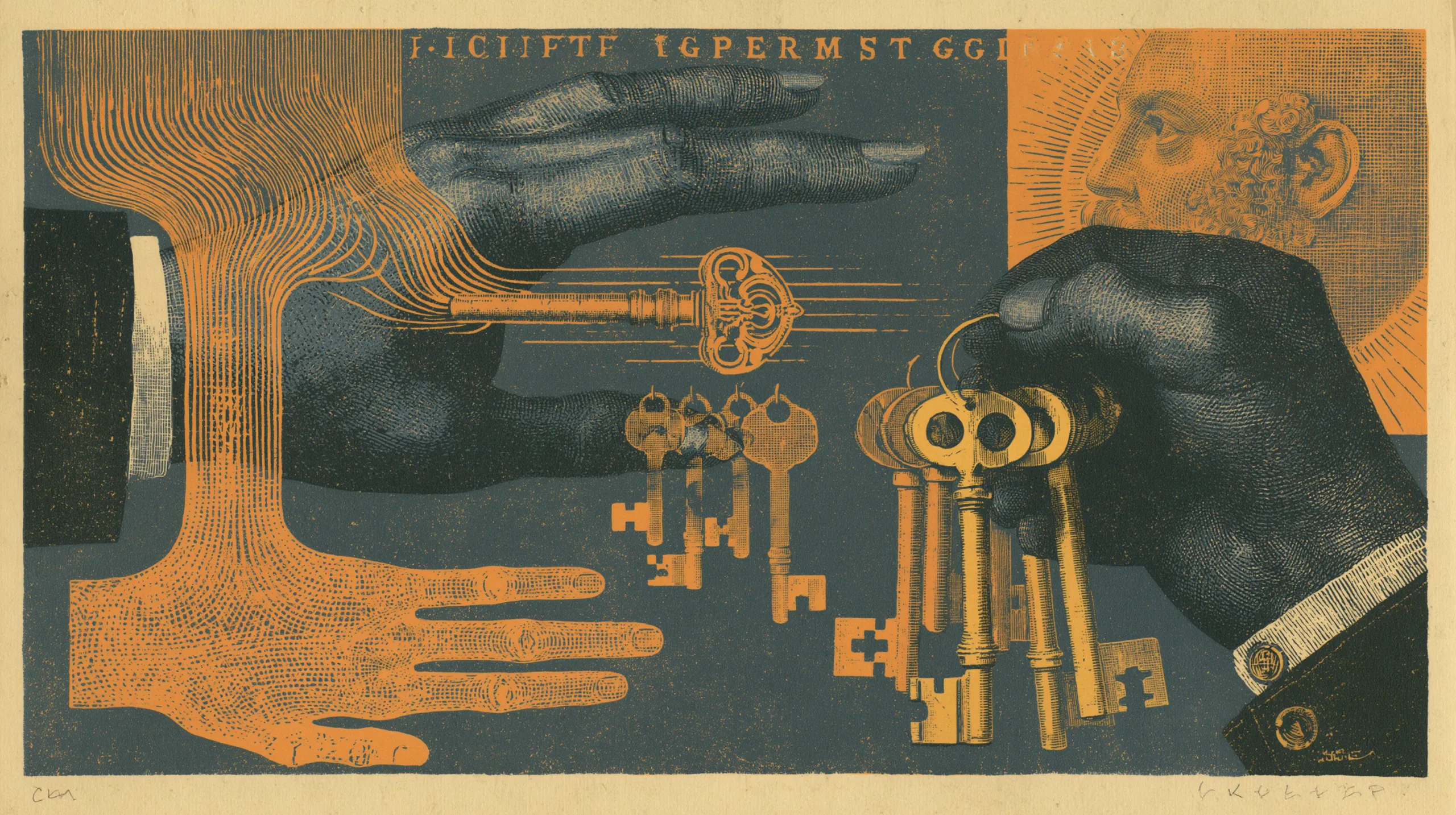
The realistic capture path for bitcoin is the gold playbook run again. Custodians hold the coins, paper claims trade instead of the asset, and everyone still prices their life in pounds.
Bitcoin has a defence, and whether it’s holding deserves the straight version, because the answer isn’t “nobody can kill it”.
Nobody needs to attack the maths
Nobody needs to kill Bitcoin at the protocol [a set of rules that lets a network operate without central control]. The maths was never the real target. The realistic path is the one that worked on gold. You don’t attack the asset, you wrap it. Get the coins into a small number of regulated vaults, let paper claims trade instead of the asset, and keep everyone thinking in the state’s unit. Do those three things and you never need to ban anything. Bitcoin wouldn’t die in that world. It would be domesticated. That word means a line item in a pension, priced in pounds, its discipline never binding anyone, while society’s real spending runs on rails the state controls. Gold is doing fine, in a vault, changing nothing.
The defence against this is a behaviour of the holders. The code can make that behaviour possible, but no line of code can do it for them. That’s why “is it holding” has a split answer. The code enforces the rules on every computer that runs it, and people decide how many computers run it, who holds the keys [the secret that lets you spend your own coins], and which unit they think in. The parts machines enforce are holding completely today, and the parts people enforce are holding at best partly.
The gold playbook, move by move
Move one. Custody has to concentrate. Gold is heavy, expensive to secure, and expensive to verify. You can’t tell a real bar from a tungsten fake without drilling it or bringing in specialist kit.1 So gold pooled into vaults out of physical necessity, first goldsmiths, then banks, then central banks.2 Once the metal sat in the vault, the claim on it circulated instead of the metal itself.3
Move two. Claims outgrow the metal. A vault can issue more paper claims than it holds metal, because on any normal day almost nobody redeems. Convertibility [the right to swap the paper for the actual gold] becomes a promise, and the promise gets suspended when the gold runs short against the claims on it. Where the gold left the vaults slowly, governments defended the promise for years first. Where it left in a sudden rush to redeem or in a war, they suspended the promise within months, and sometimes within days. Britain cut the pound’s link to gold in 1931.4 In 1933 the United States ordered citizens to hand their gold in, and the order was cheap to enforce because it ran through the custodians.5 People were told to hand their gold to the banks, and the banks handed it up, so the state worked through a known set of institutions and never had to search a house.6 In 1971 the last redemption window closed for good.7 At no point did a market choose this. A rule changed, and the holders of paper found out what their paper was.
Move three. Each time the link to gold was cut, the unit kept its name and prices kept their written form, so existing price tags, wages, and most contracts needed no rewriting. Contracts that named a weight of gold did, and in June 1933 the United States passed a law that cancelled those clauses, so those debts could be paid off dollar for dollar in ordinary money.8 Even under the gold standard, people priced bread in pounds and dollars, not in ounces. So when the link was cut, nobody had to relearn how to price anything. Prices moved afterwards, sometimes sharply, but they moved in the same unit, so people read it as prices going up. What had changed was the money itself. Gold became an investment you watch, and its visible price ran through derivative markets [contracts that track the metal’s price, letting you sell “gold” you never own and never deliver]. Those markets could blur and bend the day-to-day signal. It never got the monetary job back.
That’s the whole trick. You don’t need to break a hard asset. You need to make holding the claim more convenient than holding the asset, and keep prices quoted in your unit. Then the hard asset’s discipline never constrains you, because you can issue claims against it, gate redemption when it matters, and mute what its price is telling people. Nobody has to be running this playbook for it to run. Each move is someone’s reasonable business decision, and capture is what they add up to.
Playing it against bitcoin
The ETF [an exchange traded fund that gives exposure via a custodian] wave is move one running in real time. The pitch writes itself, and it’s not even dishonest. Keys are scary, your uncle lost his seed phrase [a list of words that can recreate a bitcoin wallet], let a professional hold it, get it inside your ISA or pension where the tax treatment works. And it works as a bridge, it really does bring in people who’d never touch keys. But one custodian holds most of the ETF coins.9 That pile is a choke point. It can be pressured by a regulator, gated with withdrawal rules sold as consumer protection, or rehypothecated [the same coins pledged against more than one claim]. And a coin in pooled custody is held at one legal address, and one address is cheap to reach with one instruction. The 1933 collection was not one address. It ran through thousands of banks, and it depended on holders complying with a deadline and a penalty.10 Even so, gold that had been gathered into vaults is what made a seizure workable, and pooled custody rebuilds that condition. A modern confiscation order takes one letter to the custodian instead of the millions of doors it would take if people held their own keys.
Move two is running too. Cash-settled futures already let you trade bitcoin’s price without ever touching a coin, so paper exposure can outgrow the real coins behind it and lean on the visible price. We watched years of this with gold. Two things are true at once here. Yes, the visible price can be muted or bent for a while, and no, that doesn’t stop the network. Blocks arrive about every ten minutes regardless of what the futures market says. But price is the recruitment signal. A noisy signal slows the arrival of the new savers who come because of the price, and that’s the damage, whether anyone intends it or not. Education and each failure of the old money keep recruiting whatever the price does.
Move three, the unit itself, is the strongest wall the old system has, which makes it the front where the new system is weakest, and it’s barely been touched. Wages, taxes, mortgages, the weekly shop, all in pounds.11 So almost everyone, including many of the people who hold bitcoin, measures it in pounds, feels clever when it’s “up”, feels sick when it’s “down”, and sells back each cycle into pounds that buy less year after year. As long as bitcoin is an asset you own inside a pound-denominated life, rather than the unit you measure your life in, the pound keeps the throne. Unit of account [the unit in which prices are quoted and contracts are denominated] is the throne. And the modern playbook has a sharper edge than gold’s ever did, because it welcomes bitcoin as an investment while steering everyday spending toward stablecoins [tokens that aim to track a fiat currency by holding assets with a custodian] and toward central bank digital currencies, which the issuing state can programme or freeze. That pairing, bitcoin as a caged asset plus state-controlled spending rails, is the full capture scenario. Same power structure as before, new reserve asset underneath it.
Where the analogy breaks, and the actual defence
Gold’s custody was structural. Bitcoin’s is optional.
Verification is nearly free. You can’t audit a vault from your kitchen. Anyone can run a node [software that checks each new block against the rules and discards any that break them] on a cheap computer, if they keep only recent blocks instead of the whole chain.12 That node lets them verify the total supply and their own coins directly.13 So paper can lie about who owns bitcoin, but it can’t lie about how much bitcoin exists. Nobody can issue more of the base asset in secret. Gold never had that property. Nobody could audit Fort Knox from home. Your node’s check is only as good as the code it runs, and that code has twice been wrong about the supply rule. Both faults were found and fixed. Open review of the code and slow, careful change to it keep that risk down.
Exit is cheap and personal. Redeeming gold meant a vault visit and a wheelbarrow, so almost nobody did it, which is what let claims outgrow metal safely. Withdrawing bitcoin from an exchange to your own keys can take minutes, and settlement is final [done and irreversible] without anyone’s permission.14 While withdrawals stay open, any holder can defect from the paper layer the moment trust wobbles. Twelve memorised words cross any border.15 The paper layer is built on a base people can leave, which disciplines it in a way gold’s paper never faced.
The rules answer to users, not to the biggest holders or custodians. Every node enforces the 21 million cap by rejecting any block that breaks the rules, and neither the miners [participants who secure the network and earn fees and block rewards] nor the largest holders get a special say.16 A fund can buy a mountain of coins and it has bought zero votes on the protocol. We know this defence works under fire because it was tested in 2017, when the biggest miners and companies in the industry backed a rule change and lost to a swarm of individually run nodes.17 If enough people verify with their own nodes and hold their own keys, an attempt to capture the rules most likely ends as a fork [a split into two rival versions of the coin] that the economic majority [the people and businesses whose acceptance gives a chain its value] ignores, and the people holding the captured version take the loss. Enough people verifying with their own nodes and holding their own keys is the defence, and it isn’t automatic.
Coin losses stop at the paper layer, too. Leverage built on top of bitcoin can wipe out the people who took it on, and it still can’t reach the base layer. When the lenders promising 8% yield collapsed in 2022, people holding paper claims lost their coins, people holding keys lost nothing, and the base layer never missed a block.18 What crosses is the price, because forced selling deepens the fall for everyone. The sellers can be holders who borrowed too much, or the people winding up a failed custodian, who sell or hand out its coins when a court says they can. There was no bailout and no socialised loss on the bitcoin side. Every one of those failures was a brutal lesson that moved people through a one-way door toward keys. The feedback loop punishes trust in custodians instead of rewarding it, the opposite of how the fiat system trains people.
So, is it holding?
Front by front, no varnish.
The base layer is holding, and strengthening. China banned mining, which was the single biggest concentration risk at this layer, and the network rerouted within months.19 There’s no credible protocol-level kill visible today. Quantum computing is a real long-term problem, but the fix is a slow, social, messy upgrade you can plan for, a lock you replace before the burglar arrives, not an ambush. I hold that with humility rather than certainty.
Custody is contested, and I won’t dress this up. The ETF brought in capital and legitimacy, and it concentrated coins into exactly the structure the playbook needs. Both facts are true. The counterweights are real too, because long-term holders keep pulling coins into cold storage [keys kept offline to reduce theft risk], shrinking the freely tradable supply. And the bridge does move some people onward, from ETF to wallet to node, and they rarely go back. The bridge is doing bridge work and building the choke point at the same time. Which effect wins depends on whether people cross it or settle down and live on it.
Paper claims are partly holding. Derivatives can lean on the price for stretches, and that’s a real cost because it dulls the signal that recruits savers. But paper can’t stop settlement, can’t inflate the base asset, and a shrinking float [units available for trading in the short term] eventually punishes anyone selling claims on coins they don’t have, violently. A derivatives exchange can demand bigger deposits from traders, cap how big a bet anyone can hold, or cancel trades, so it can stop a squeeze on its own market. But rules can’t conjure the coins, and a cancelled trade is that exchange’s own paper failing. Muted isn’t dead.
The unit isn’t holding yet, and it’s the weakest front. I’d rather say so plainly than have you build on a soft foundation. Nearly everyone still prices their life in pounds, including many of the people who hold bitcoin. Fiat as the mental unit is itself a quiet form of capture, because it makes the ETF feel sensible, makes selling cycles feel rational, and keeps the economic gravity inside the old system. This is exactly why bitcoin has to become money people use, earn, and spend, rather than a number they watch. If it stays a hoarded investment on fiat rails forever, the gold outcome is available. Custodied, papered, priced in pounds, changing nothing. Nobody has to kill it to get there. That is the realistic defeat, and it arrives as convenience.
What tips the last front is usage, education, and time. Payments over Lightning [a payment network built on Bitcoin that settles small payments fast and for almost nothing], circular economies [communities where people earn and spend in bitcoin without converting to fiat] growing at the edges where people are furthest from control of their own money, spend-and-replace habits [spending bitcoin and immediately repurchasing to maintain holdings], each custodial failure teaching keys, each round of debasement [reducing a currency’s purchasing power by increasing its supply] recruiting the people it hurt.20 The tools also have to get good enough that crossing the bridge is easy.
Money adoption runs in sequence. Store of value [holding purchasing power across time] first, medium of exchange [using money to buy and sell goods and services] second, unit of account last and slowest. We’re early in that sequence. Store of value is established, medium of exchange is contested, unit of account has barely begun.
Bitcoin can’t be killed from the outside while people verify and hold their own keys, and it can absolutely be hollowed out from the inside if they don’t. Everything else I argue rests on this. If Bitcoin stays decentralised and secure, the rest can follow. If it doesn’t, it drifts back into the system it was built to leave. And staying decentralised and secure isn’t the only thing that has to hold, because bitcoin also has to become money people use, and a hard asset can keep its rules and still lose the monetary job. The code settles what’s possible. The holders settle what actually happens. The defence is holding exactly where it’s automatic, and only partly where it’s chosen. And that’s the one part of this story you decide.
Sources 20
What this essay rests on, as checked on 12 November 2026.
- 1 London Bullion Market Association, Good Delivery Rules and Governance: "The only way to accurately determine the fineness of a gold bar is through destructive testing of representative samples."
- 2 Bank of England, Museum online collection page, "Our earliest Bank of England note": Paper money in Britain "evolved from the receipts that goldsmiths gave their customers for the money that they had deposited for safekeeping". The page covers goldsmiths and the Bank of England's own notes from 1694, and prints nothing on other banks.
- 3 Bank of England, Museum online collection page, "Early banknotes" (1697 and 1699 notes): "It promises to pay the bearer £22, which means it could be exchanged for that value of gold." The page says nothing about notes passing from hand to hand.
- 4 Bank of England, Quarterly Bulletin article, "Bank of England's holdings of gold and foreign exchange 1924-31": "the United Kingdom was on the gold standard (from the end of April 1925-September 1931)"
- 5 Franklin D. Roosevelt, President of the United States, Executive Order 6102, "Forbidding the Hoarding of Gold Coin, Gold Bullion and Gold Certificates", 5 April 1933: "All persons are hereby required to deliver on or before May 1, 1933, to a Federal Reserve Bank or a branch or agency thereof or to any member bank of the Federal Reserve System all gold coin, gold bullion and gold certificates"
- 6 Franklin D. Roosevelt, President of the United States, Executive Order 6102, "Forbidding the Hoarding of Gold Coin, Gold Bullion and Gold Certificates", 5 April 1933: Delivery required "to a Federal Reserve Bank or a branch or agency thereof or to any member bank of the Federal Reserve System", of "all gold coin, gold bullion and gold certificates now owned by them". Federal Reserve, Federal Reserve History essay, "Gold Reserve Act of 1934": "Section 2 of the act transferred ownership of all monetary gold in the United States to the US Treasury." The transfer covered all coins and bullion held by individuals and institutions, not only the banks'.
- 7 Federal Reserve, Federal Reserve History essay, "Nixon Ends Convertibility of U.S. Dollars to Gold and Announces Wage/Price Controls": "The first order was for the gold window to be closed." "Foreign governments could no longer exchange their dollars for gold; in effect, the international monetary system turned into a fiat one." Dated August 15, 1971. Richard Nixon, President of the United States, Address to the Nation Outlining a New Economic Policy: "The Challenge of Peace", 15 August 1971: "I have directed Secretary Connally to suspend temporarily the convertibility of the dollar into gold or other reserve assets"
- 8 United States Congress, Joint Resolution of 5 June 1933 (H.J.Res. 192, Public Resolution No. 10, 73rd Congress), United States Statutes at Large, Volume 48, page 112: "Every provision ... which purports to give the obligee a right to require payment in gold ... is declared to be against public policy"; "Approved June 5, 1933, 4:40 PM".
- 9 Coinbase Global, Inc., Q3 2025 shareholder letter, filed 30 October 2025: "the primary custodian for over 80% of U.S. BTC and ETH ETF assets as of quarter-end". The figure covers bitcoin and ether ETF assets together, measured in assets, not bitcoin ETF coins alone. iShares Bitcoin Trust ETF, Annual report on Form 10-K for the financial year ended 31 December 2025: "The assets of the Trust consist primarily of bitcoin held by a custodian on behalf of the Trust." "Coinbase Custody Trust Company, LLC serves as the custodian for the Trust's bitcoin holdings".
- 10 President Franklin D. Roosevelt, Executive Order 6102, 5 April 1933, "Forbidding the Hoarding of Gold Coin, Gold Bullion and Gold Certificates": "All persons are hereby required to deliver on or before May 1, 1933 ... to any member bank of the Federal Reserve System"; "may be fined not more than $10,000 ... or imprisoned for not more than ten years". Board of Governors of the Federal Reserve System, Banking and Monetary Statistics, 1914–1941, Part I: Member banks: 5,606 on 30 June 1933 (4,897 national, 709 State); 6,011 on 30 December 1933.
- 11 United Kingdom Government (legislation.gov.uk), The Price Marking Order 2004 (S.I. 2004 No. 102), article 6: "The indication of selling price and unit price shall be in sterling." United Kingdom Government (GOV.UK), Guidance page, “Pay taxes, penalties and enquiry settlements”: "You must make all payments in pound sterling (GBP). Your bank may charge you if you use any other currency."
- 12 bitcoin.org, Running A Full Node: "It is possible to configure your node to run in pruned mode in order to reduce storage requirements. This can reduce the disk usage from over 750GB to around 7GB." Minimum requirements as printed: 7 GB free disk, 2 GB RAM.
- 13 Bitcoin Core, Bitcoin Core 30.0 RPC documentation, gettxoutsetinfo: "Returns statistics about the unspent transaction output set." / "total_amount : (numeric) The total amount of coins in the UTXO set"
- 14 Coin Center, How long does it take for a Bitcoin transaction to be confirmed?, 3 November 2015: "On average, it takes about 10 minutes to find each block." That figure is the average time to find a block, not the end-to-end time for an exchange to process and send a withdrawal.
- 15 Bitcoin Improvement Proposals, BIP 39, "Mnemonic code for generating deterministic keys", assigned 2013-09-10: "The allowed size of ENT is 128-256 bits." Table row "| 128 | 4 | 132 | 12 |": 12 words for 128 bits of entropy.
- 16 Bitcoin.org, Frequently Asked Questions: "Bitcoin is unique in that only 21 million bitcoins will ever be created" and "it is not possible to generate uncontrolled amounts of bitcoins out of thin air". Bitcoin Core, Bitcoin Core source code, src/consensus/amount.h: "inline constexpr CAmount MAX_MONEY{21'000'000 * COIN};" — 21,000,000 BTC. The file's own comment says this constant is "*not* the total money supply" but "rather a sanity check".
- 17 CoinDesk, "2x Called Off: Bitcoin Hard Fork Suspended for Lack of Consensus", 8 November 2017: "Unfortunately, it is clear that we have not built sufficient consensus for a clean block size upgrade at this time." / "Until then, we are suspending our plans for the upcoming 2MB upgrade." Segwit2x organisers, bitcoin-segwit2x mailing list, "Segwit2x Final Steps": "Unfortunately, it is clear that we have not built sufficient consensus for a clean blocksize upgrade at this time." The notice says nothing about node and user support, and the readable page carries no date, so the 8 November 2017 date is unverified.
- 18 Celsius Network, Chapter 11 case record (Stretto), Celsius Network Bankruptcy Filing, Case No. 22-10964, filing date 13 July 2022: "On July 13, 2022, Celsius Network LLC and certain of its affiliates (collectively, the 'Celsius Debtors') filed voluntary petitions for relief under Chapter 11." Case No. 22-10964, Southern District of New York.
- 19 Cambridge Centre for Alternative Finance, Bitcoin Mining Map, Cambridge Bitcoin Electricity Consumption Index: "Since the government crackdown on the mining industry in June 2021, no data has been available – and the migrations have likely become a phenomenon of the past." Date printed: June 2021. Cambridge Judge Business School, News article, 2022, “Bitcoin mining – an (un)surprising resurgence?”: "the trend quickly reversed as miners began to relocate operations abroad"; hashrate bottomed at 57.47 EH/s on 27 June 2021 and recovered to 193.64 EH/s, near pre-ban levels, by 21 December 2021.
- 20 Lightning Network, Project website, “Lightning Network — Scalable, Instant Bitcoin/Blockchain Transactions”: "Payment speed measured in milliseconds to seconds"; fees "exceptionally low," enabling "instant micropayments". The page states no fee amount in pence or cents.